EMISSION CONTROL SYSTEM (for Unleaded Gasoline Specification Vehicle) > ON-VEHICLE INSPECTION |
| 1. VISUALLY CHECK HOSES, CONNECTIONS AND GASKETS |
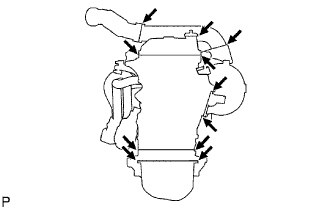 |
Check that there are no cracks, leaks or damage.
| 2. CHECK VACUUM SWITCHING VALVE (for EVAP) |
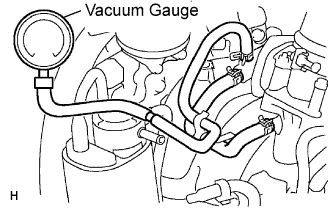 |
Check that the vacuum hose is connected correctly.
Disconnect the vacuum hose from the canister, and connect a vacuum gauge.
Using the flowchart below, perform a VSV operation inspection when the engine coolant temperature is 55°C (131°F) or less (while the engine is cold (VSV is closed)).
VSV operation flowchart.
1. When engine is idling or running and at 2,500 rpm, the vacuum gauge indicates 1 kPa (25 mmHg, 0.3 in.Hg) or less.
| Result | Procedure |
| Yes | VSV operation normal |
| No | Go to next step |
| Result | Procedure |
| OK | Check wire harness and ECM |
| NG | Replace VSV |
Using the flowchart below, perform a VSV operation inspection when the engine coolant temperature is 80°C (146°F) or more (while the engine is hot (VSV is opened)).
VSV operation flowchart.
1. When engine is idling, the vacuum gauge indicates 40 kPa (300 mmHg, 11.8 in.Hg) or more.
| Result | Procedure |
| Yes | VSV operation normal |
| No | Go to next step |
| Result | Procedure |
| OK | Check wire harness and ECM |
| NG | Replace VSV |
