DTC    P0500/42    Vehicle Speed Sensor "A"

for Preparation Click here


DESCRIPTION

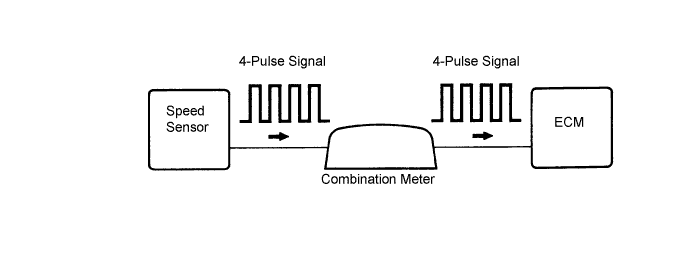
The vehicle speed sensor outputs a 4-pulse signal for every revolution of the rotor shaft, which is rotated by the transmission output shaft via the driven gear. After this signal is converted into a more precise rectangular waveform by the waveform shaping circuit inside the combination meter, it is then transmitted to the ECM. The ECM determines the vehicle speed based on the frequency of these pulse signals.

G036461E02


DTC No.
DTC Detection Condition
Trouble Area
P0500/42
Conditions (a), (b) and (c) continue for 7 seconds or more:
(1 trip detection logic)
(a) Engine coolant temperature is more than 70°C (158°F)
(b) Engine speed is between 2,650 rpm and 3,500 rpm
(c) No speed signal is input to ECM
  1. Open or short in speed sensor circuit
  2. Speed sensor
  3. Combination meter
  4. ECM

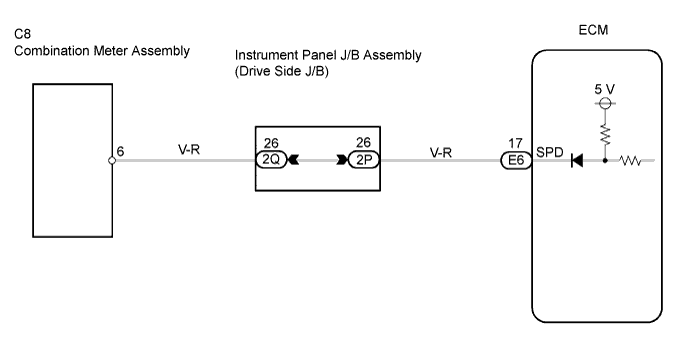
WIRING DIAGRAM


A099781E02


INSPECTION PROCEDURE

HINT:
Read freeze frame data using the intelligent tester. Freeze frame data records the engine conditions when a malfunction is detected. When troubleshooting, freeze frame data can help determine if the vehicle was running or stopped, if the engine was warmed up or not, and other data from the time the malfunction occurred.

NOTICE:
If the ECM is replaced, the new ECM needs initialization (Click here).


When using intelligent tester:

1.CHECK OPERATION OF SPEEDOMETER
  1. Check the speedometer reading in the combination meter.

    HINT:
    If the vehicle speed sensor has any malfunctions, the speedometer shows abnormal readings.

    OK:
    Speedometer operates normally.


NG
CHECK SPEEDOMETER CIRCUIT (INCLUDING SPEED SENSOR)
OK


2.READ DATA LIST (VEHICLE SPEED)
  1. Connect the intelligent tester to the DLC3.

  1. Start the engine and turn the intelligent tester ON.

  1. Enter the following menus: Powertrain / Engine / Data List / Vehicle Speed.

  1. While the vehicle is running, check the vehicle speed at an engine speed of 2,000 rpm or more.

    OK:
    Same value as actual vehicle speed.


YES
CHECK FOR INTERMITTENT PROBLEMS
NO


3.CHECK ECM (SPD SIGNAL)
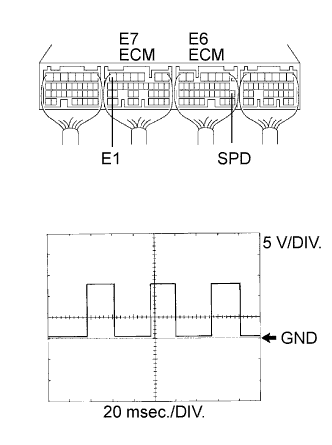
G036576E02
  1. While idling the engine, check the waveform of the ECM connectors using an oscilloscope.

    1. Move the shift lever to N.

    2. Jack up the vehicle.

    3. Turn the ignition switch ON.

    4. Measure the voltage of the ECM connectors as the wheel is turned slowly.

      Standard voltage:
      Tester Connection
      Specified Condition
      E6-17 (SPD) - E7-7 (E1)
      Correct waveform is shown

      Tool Setting
      Condition
      5 V/DIV., 20 msec./DIV.
      Turn the rear wheel slowly

      HINT:
      When the wheel is turning slowly, voltage is output intermittently.


NG
REPAIR OR REPLACE HARNESS AND CONNECTOR
OK

REPLACE ECM 


When not using intelligent tester:

1.CHECK OPERATION OF SPEEDOMETER
  1. Check the speedometer reading in the combination meter.

    HINT:
    If the vehicle speed sensor has any malfunctions, the speedometer shows abnormal readings.

    OK:
    Speedometer operates normally.


NG
CHECK SPEEDOMETER CIRCUIT (INCLUDING SPEED SENSOR)
OK


2.CHECK ECM (SPD SIGNAL)
G036576E02
  1. While idling the engine, check the waveform of the ECM connectors using an oscilloscope.

    1. Move the shift lever to N.

    2. Jack up the vehicle.

    3. Turn the ignition switch ON.

    4. Measure the voltage of the ECM connectors as the wheel is turned slowly.

      Standard voltage:
      Tester Connection
      Specified Condition
      E6-17 (SPD) - E7-7 (E1)
      Correct waveform is shown

      Tool Setting
      Condition
      5 V/DIV., 20 msec./DIV.
      Turn the rear wheel slowly

      HINT:
      When the wheel is turning slowly, voltage is output intermittently.


NG
REPAIR OR REPLACE HARNESS AND CONNECTOR
OK

REPLACE ECM