LOAD SENSING PROPORTIONING VALVE > ON-VEHICLE INSPECTION |
| 1. CHECK LOAD SENSING PROPORTIONING VALVE ASSEMBLY |
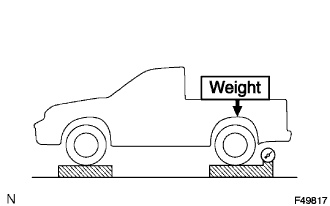 |
Set the vehicle to its curb weight.
Place weights (as necessary) on the rear deck until the rear axle load is shown below.
| Vehicle Type | Rear Axle Load |
| 2WD Single Cab | 7,845 N (800 kgf, 1,764 lbf) |
| 2WD Extra Cab | 8,336 N (850 kgf, 1,874 lbf) |
| 2WD Double Cab | 8,826 N (900 kgf, 1,984 lbf) |
| 4WD | 9,807 N (1,000 kgf, 2,205 lbf) |
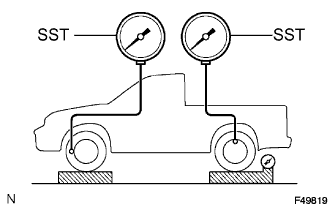 |
Set SST, and bleed air from the brake system.
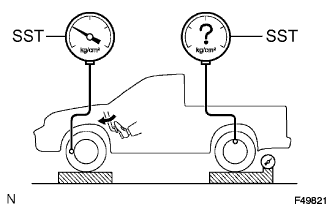 |
Raise the front brake fluid pressure to 10,000 kPa (107.6 kgf/cm2, 1,450 psi) when the brake pedal is depressed, and measure the rear brake fluid pressure.
| Vehicle Type | Rear Brake Fluid Pressure |
| 2WD | 5,260 +- 490 kPa (53.6 +- 5.0 kgf/cm2, 762 +- 71 psi) |
| 4WD | 4,450 +- 490 kPa (45.4 +- 5.0 kgf/cm2, 645 +- 71 psi) |
| 2. ADJUST LOAD SENSING PROPORTIONING VALVE ASSEMBLY |
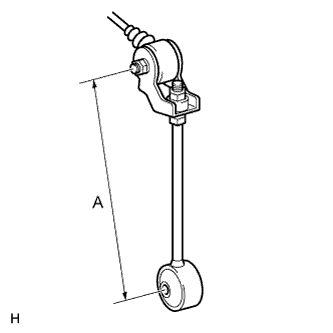 |
Adjust the length of the No. 2 shackle
For lower pressure - Lengthen "A"
For higher pressure - Shorten "A"
| Vehicle Type | "A" length |
| 2WD | 120 mm (4.764 in.) |
| 4WD | 190 mm (7.543 in.) |
| Vehicle Type | "A" length |
| 2WD | 114 to 126 mm (4.526 to 5.002 in.) |
| 4WD | 184 to 196 mm (7.305 to 7.781 in.) |
| Vehicle Type | For 1 mm (0.039 in.) of the "A" length |
| 2WD | 140 kPa (1.4 kgf/cm2, 20.5 psi) |
| 4WD | 120 kPa (1.2 kgf/cm2, 17.6 psi) |
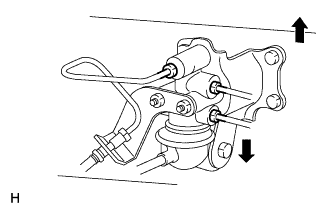 |
If the pressure cannot be adjusted by the No. 2 shackle, raise or lower the valve body.
For lower pressure - Lower the valve body
For higher pressure - Raise the valve body
Tighten the nuts.
Adjust the length of the No. 2 shackle again.
| 3. CHECK VALVE BODY |
Check that the master cylinder rear pressure changes according to the rear wheel cylinder pressure.
| Vehicle Type | Master Cylinder Pressure | Wheel Cylinder Pressure |
| 2WD | 2,450 kPa (25 kgf/cm2, 356 psi) | 1,350 +- 200 kPa (14 +- 2 kgf/cm2, 196 +- 29 psi) |
| 2WD | 5,880 kPa (59 kgf/cm2, 855 psi) | 2,210 +- 340 kPa (22 +- 3 kgf/cm2, 321 +- 49 psi) |
| 4WD | 2,940 kPa (29 kgf/cm2, 428 psi) | 1,270 +- 200 kPa (13 +- 2 kgf/cm2, 185 +- 29 psi) |
| 4WD | 1,720 kPa (59 kgf/cm2, 855 psi) | 1,720 +- 340 kPa (17 +- 3 kgf/cm2, 250 +- 49 psi) |
