DTC P0011/59 Camshaft Position "A" - Timing Over-Advanced or System Performance (Bank 1) |
DTC P0012/59 Camshaft Position "A" - Timing Over-Retarded (Bank 1) |
| DTC No. | DTC Detection Condition | Suspected Area |
| P0011/59 | Advanced cam timing: After engine is warmed up, valve timing does not change from current valve timing while driving at engine speed of 500 to 4,000 rpm (1 trip detection logic) |
|
| P0012/59 | Retarded cam timing: After engine is warmed up, valve timing does not change from current valve timing while driving at engine speed of 500 to 4,000 rpm (2 trip detection logic) |
|
| Condition | DTC |
| Advanced timing over (valve timing is out of specified range) | P0011/59 |
| Retarded timing over (valve timing is out of specified range) | P0012/59 |
| 1.PERFORM ACTIVE TEST (OPERATE OCV) |
Start and warm up the engine.
Turn the ignition switch OFF.
Connect the intelligent tester to the DLC3.
Turn the ignition switch ON and turn the intelligent tester ON.
Enter the following menus: Powertrain / Engine and ECT / Active Test / Activate the VVT System (Bank 1).
Using the intelligent tester, operate the OCV and check the engine speed.
| Tester Operation | Specified Condition |
| OCV is OFF | Normal engine speed |
| OCV is ON | Rough idle or engine stall |
|
| ||||
| OK | |
 |
| 2.CHECK IF DTC OUTPUT RECURS (DTC P0011/59 OR P0012/59) |
Clear the DTCs using the intelligent tester (Click here).
Start the engine and warm it up.
Drive the vehicle for 10 minutes or more.
Read output DTC using the intelligent tester.
|
| ||||
| NG | |
|
| 3.CHECK VALVE TIMING |
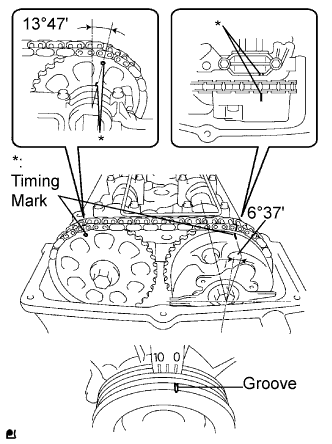 |
Remove the cylinder head cover.
Turn the crankshaft to align the timing marks of the crankshaft.
Align the groove of the crankshaft pulley with the "0" position.
Confirm whether the timing marks of the camshaft pulley and cylinder head cover are facing each other.
If the timing marks are not facing each other, turn the crankshaft clockwise by 360°. Confirm again if the timing marks are facing each other.
|
| ||||
| OK | |
|
| 4.CHECK ECM (OCV SIGNAL) |
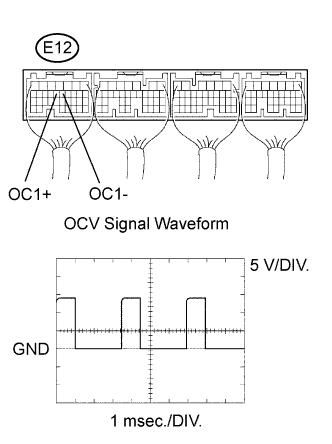 |
While idling, check the waveform of the ECM connector using the oscilloscope.
| Tester Connection | Specified Condition |
| E12-13 (OC1+) - E12-12 (OC1-) | Correct waveform is as shown |
| Tool setting | 5 V/DIV., 1 msec./DIV. |
| Condition | Accelerate slowly after engine warm-up |
|
| ||||
| OK | |
|
| 5.CHECK OIL CONTROL VALVE FILTER |
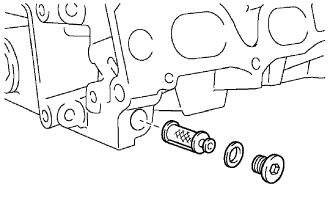 |
Remove the OCV filter.
Check that the filter is not clogged.
|
| ||||
| OK | |
|
| 6.INSPECT CAMSHAFT TIMING OIL CONTROL VALVE ASSEMBLY (OCV) |
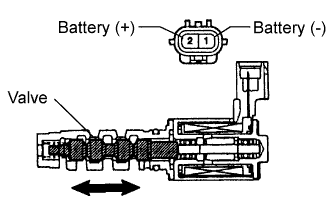 |
Measure the resistance between the terminals of the OCV.
Remove the OCV.
Apply positive (+) battery voltage to terminal 2 and negative (-) battery voltage to terminal 1. Check the valve operation.
|
| ||||
| NG | |
|
| 7.REPLACE CAMSHAFT TIMING OIL CONTROL VALVE ASSEMBLY (OCV) |
| NEXT | |
|
| 8.CHECK CAMSHAFT TIMING GEAR ASSEMBLY |
|
| ||||
| NG | |
|
| 9.REPLACE CAMSHAFT TIMING GEAR ASSEMBLY |
| NEXT | |
|
| 10.CHECK FOR BLOCKAGE (OCV, OIL CHECK VALVE, OIL HOLE) |
|
| ||||
| OK | |
|
| 11.CHECK IF DTC OUTPUT RECURS (DTC P0011/59 OR P0012/59) |
Clear the DTCs using the intelligent tester (Click here).
Start the engine and warm it up.
Drive the vehicle for 10 minutes or more.
Read output DTC using the intelligent tester.
|
| ||||
| NG | ||
 | ||
| ||
| 1.CHECK VALVE TIMING |
|
Remove the cylinder head cover.
Turn the crankshaft to align the timing marks of the crankshaft.
Align the groove of the crankshaft pulley with the "0" position.
Confirm whether the timing marks of the camshaft pulley and cylinder head cover are facing each other.
If the timing marks are not facing each other, turn the crankshaft clockwise by 360°. Confirm again if the timing marks are facing each other.
|
| ||||
| OK | |
|
| 2.CHECK ECM (OPERATION OF OCV) |
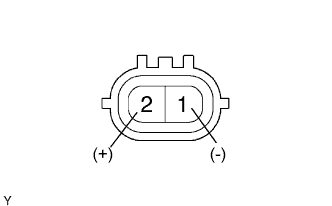 |
Start the engine.
Check the engine speed.
Disconnect the C14 OCV connector. Check the engine speed.
Apply positive (+) battery voltage between the terminals of the OCV. Check the engine speed.
|
| ||||
| A | |
|
| 3.CHECK IF DTC OUTPUT RECURS (DTC P0011/59 OR P0012/59) |
Clear the DTCs.
Disconnect the battery terminal or remove the EFI and ETCS fuses for more than 60 seconds.
Start the engine and warm it up.
Drive the vehicle for 10 minutes or more.
Read output DTC.
|
| ||||
| NG | |
|
| 4.CHECK ECM (OCV SIGNAL) |
|
While idling, check the waveform of the ECM connector using the oscilloscope.
| Tester Connection | Specified Condition |
| E12-13 (OC1+) - E12-12 (OC1-) | Correct waveform is as shown |
| Tool setting | 5 V/DIV., 1 msec./DIV. |
| Condition | Accelerate slowly after engine warm-up |
|
| ||||
| OK | |
|
| 5.CHECK OIL CONTROL VALVE FILTER |
|
| ||||
| OK | |
|
| 6.CHECK CAMSHAFT TIMING OIL CONTROL VALVE ASSEMBLY (OCV) |
|
Measure the resistance between the terminals of the OCV.
Remove the OCV.
Apply positive (+) battery voltage to terminal 2 and negative (-) battery voltage to terminal 1. Check the valve operation.
|
| ||||
| NG | |
|
| 7.REPLACE CAMSHAFT TIMING OIL CONTROL VALVE ASSEMBLY (OCV) |
| NEXT | |
|
| 8.CHECK CAMSHAFT TIMING GEAR ASSEMBLY |
|
| ||||
| NG | |
|
| 9.REPLACE CAMSHAFT TIMING GEAR ASSEMBLY |
| NEXT | |
|
| 10.CHECK FOR BLOCKAGE (OCV, OIL CHECK VALVE, OIL HOLE) |
|
| ||||
| OK | |
|
| 11.CHECK IF DTC OUTPUT RECURS (DTC P0011/59 OR P0012/59) |
Clear the DTCs.
Disconnect the battery cable or remove the EFI and ETCS fuses for more than 60 seconds.
Start and warm up the engine.
Drive the vehicle for 10 minutes or more.
Read output DTC.
|
| ||||
| NG | ||
| ||
| ||


