DTC    P0420    Catalyst System Efficiency Below Threshold (Bank 1)

for Preparation Click here


DESCRIPTION

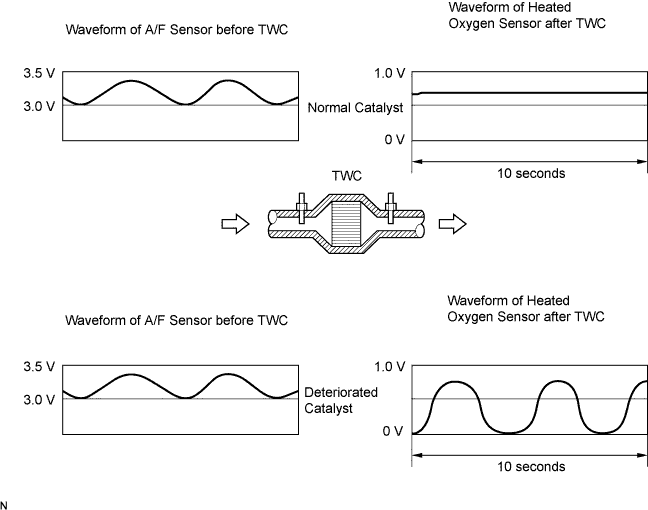
The ECM uses 2 sensors located in front of and behind the Three-Way Catalytic Converter (TWC) to monitor its efficiency. The Air-fuel Ratio (A/F) sensor (sensor 1) sends pre-catalyst information to the ECM. The Heated Oxygen (HO2) sensor (sensor 2) sends post-catalyst information to the ECM. The ECM compares these two signals to judge the efficiency of the catalyst and the catalyst's ability to store oxygen. During normal operation the TWC stores and releases oxygen as needed. The capacity to store oxygen results in a low variation in the post-TWC exhaust stream as shown below.
If the catalyst is functioning normally, the waveform of the HO2 sensor slowly changes between rich and lean. If the catalyst is deteriorated, the waveform will fluctuate frequently between rich and lean. As the catalyst efficiency degrades, its ability to store oxygen is reduced and the catalyst output becomes more variable.
When running the monitor, the ECM compares sensor signals before and after the TWC over a specific amount of time to determine catalyst efficiency. The ECM begins the comparison by calculating the signal length for both sensors (using each output voltage of the sensors). If the HO2 sensor signal length is greater than the threshold (the threshold is calculated based on the A/F sensor signal length), the ECM concludes that the TWC is malfunctioning.
The ECM will turn on the MIL and the DTC will be set.

A107145E05


DTC No.
DTC Detection Condition
Trouble Area
P0420
After engine and catalyst are warmed up, and while vehicle is driven within set vehicle speed and engine speed range: Waveform of heated oxygen sensor frequently fluctuates between rich and lean (2 trip detection logic)
  1. Gas leakage in exhaust system
  2. A/F sensor (sensor 1)
  3. Heated oxygen sensor (sensor 2)
  4. Three-Way catalytic converter

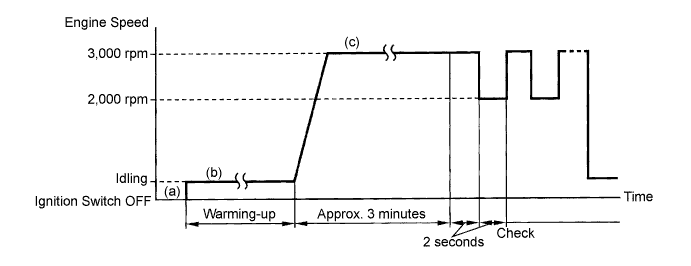
CONFIRMATION DRIVING PATTERN


A093766E02

(a) Start the engine and warm it up with all the accessories turned OFF until the engine coolant temperature becomes stable.
(b) Run the engine at 2,500 to 3,000 rpm for approximately 3 minutes.
(c) Rev the engine to 3,000 rpm for 2 seconds and 2,000 rpm for 2 seconds alternately.
  1. A/F CONTROL

    HINT:
    Malfunctioning areas can be identified by performing the A/F Control function provided in the Active Test.
    The A/F Control function can help to determine whether the Air-fuel Ratio (A/F) sensor, heated oxygen (HO2) sensor and other potential trouble areas are malfunctioning.
    The following instructions describe how to conduct the A/F Control operation using the intelligent tester.

    1. Connect the intelligent tester to the DLC3.
    2. Start the engine and turn the tester ON.
    3. Warm up the engine at an engine speed of 2,500 rpm for approximately 90 seconds.
    4. On the tester, select the following menu items: Powertrain / Engine and ECT / Active Test / A/F Control.
    5. Perform the A/F Control operation with the engine in an idling condition (press the RIGHT or LEFT button to change the fuel injection volume).
    6. Monitor the output voltage of the A/F and HO2 sensors (AFS B1 S1 and O2S B1 S2) displayed on the tester.

    HINT:
    1. The A/F Control operation lowers the fuel injection volume by 12.5% or increases the injection volume by 25%.
    2. Each sensor reacts in accordance with increases in the fuel injection volume.


    Standard:

    Tester Display
    (Sensor)
    Injection Volume
    Status
    Voltage
    AFS B1 S1
    (A/F)
    +25%
    Rich
    Less than 3.0 V
    AFS B1 S1
    (A/F)
    -12.5%
    Lean
    More than 3.35 V
    O2S B1 S2
    (HO2)
    +25%
    Rich
    More than 0.55 V
    O2S B1 S2
    (HO2)
    -12.5%
    Lean
    Less than 0.4 V

NOTICE:
The Air-fuel Ratio (A/F) sensor has an output delay of a few seconds and the Heated Oxygen (HO2) sensor has a maximum output delay of approximately 20 seconds.


Case
A/F Sensor (Sensor 1)
Output Voltage
HO2 Sensor (Sensor 2)
Output Voltage
Main Suspected Trouble Area
1
Injection Volume
+25%
-12.5%
A103184
Injection Volume
+25%
-12.5%
A103184
-
Output Voltage
More than 3.35 V
Less than 3.0 V
A107708
Output Voltage
More than 0.55 V
Less than 0.4 V
A103186
2
Injection Volume
+25%
-12.5%
A103184
Injection Volume
+25%
-12.5%
A103184
  1. A/F sensor
  2. A/F sensor heater
    A/F sensor circuit
Output Voltage
Almost
no reaction
A103185
Output Voltage
More than 0.55 V
Less than 0.4 V
A103186
3
Injection Volume
+25%
-12.5%
A103184
Injection Volume
+25%
-12.5%
A103184
  1. HO2 sensor
  2. HO2 sensor heater
  3. HO2 sensor circuit
Output Voltage
More than 3.35 V
Less than 3.0 V
A107708
Output Voltage
Almost
no reaction
A103185
4
Injection volume
+25%
-12.5%
A103184
Injection Volume
+25%
-12.5%
A103184
  1. Injector
  2. Fuel pressure
  3. Gas leakage from exhaust system
    (Air-fuel ratio extremely lean or rich)
Output Voltage
Almost
no reaction
A103185
Output Voltage
Almost
no reaction
A103185
  1. The following A/F Control procedure enables the technicians to check and graph the output voltages of both A/F sensor and heated oxygen sensor.
  2. To display the graph, select the following menu items on the tester: View / Line graph.

INSPECTION PROCEDURE

HINT:
Read freeze frame data using the intelligent tester. Freeze frame data records the engine conditions when malfunctions are detected. When troubleshooting, freeze frame data can help determine if the vehicle was moving or stationary, if the engine was warmed up or not, if the air-fuel ratio was lean or rich, and other data from the time the malfunction occurred.

1.CHECK OTHER DTCS OUTPUT (IN ADDITION TO DTC P0420)
  1. Connect the intelligent tester to the DLC3.

  1. Turn the ignition switch ON and turn the intelligent tester ON.

  1. Select the following menu items: Powertrain / Engine and ECT / DTC.

  1. Read DTCs.

    Result:
    Display (DTC output)
    Proceed to
    P0420
    A
    P0420 and other DTCs
    B

    HINT:
    If any other DTCs besides P0420 are output, perform troubleshooting for those DTCs first.


B
GO TO RELEVANT DTC CHART
A


2.PERFORM ACTIVE TEST (A/F CONTROL)
  1. Connect the intelligent tester to the DLC3.

  1. Start the engine and turn the tester ON.

  1. Warm up the engine at an engine speed of 2,500 rpm for approximately 90 seconds.

  1. On the tester, select the following menu items: Powertrain / Engine and ECT / Active Test / A/F Control.

  1. Perform the A/F Control operation with the engine in an idling condition (press the right or left button to change the fuel injection volume.)

  1. Monitor the output voltages of the A/F and HO2 sensors (AFS B1 S1 and O2S B1 S2 or AFS B2S1 and O2S B2S2) displayed on the tester.

    HINT:
    1. The A/F Control operation lowers the fuel injection volume by 12.5% or increases the injection volume by 25%.
    2. Each sensor reacts in accordance with increases and decreases in the fuel injection volume.


    Standard: 
    Tester Display
    (Sensor)
    Injection Volume
    Status
    Voltage
    AFS B1 S1
    (A/F)
    +25%
    Rich
    Less than 3.0 V
    AFS B1 S1
    (A/F)
    -12.5%
    Lean
    More than 3.35 V
    O2S B1 S2
    (HO2)
    +25%
    Rich
    More than 0.55 V
    O2S B1 S2
    (HO2)
    -12.5%
    Lean
    Less than 0.4 V

    Result: 
    Status
    AFS B1 S1
    Status
    O2S B1 S2
    A/F Condition and A/F and
    HO2 Sensor Condition
    Misfire
    Main Suspected Trouble Areas
    Proceed to
    Lean/Rich
    Lean/Rich
    Normal
    -
    1. Three-Way Catalytic Converter (TWC)
    2. Gas leakage from exhaust system
    A
    Lean
    Lean/Rich
    A/F sensor malfunction
    -
    1. A/F sensor
    B
    Rich
    Lean/Rich
    A/F sensor malfunction
    -
    1. A/F sensor
    B
    Lean/Rich
    Lean
    HO2 sensor malfunction
    -
    1. HO2 sensor
    2. Gas leakage from exhaust system
    C
    Lean/Rich
    Rich
    HO2 sensor malfunction
    -
    1. HO2 sensor
    2. Gas leakage from exhaust system
    C
    Lean
    Lean
    Actual air-fuel ratio lean
    May occur
    1. Extremely rich or lean actual air-fuel ratio
    2. Gas leakage from exhaust system
    A
    Rich
    Rich
    Actual air-fuel ratio lean
    -
    1. Extremely rich or lean actual air-fuel ratio
    2. Gas leakage from exhaust system
    A

Lean: During A/F Control, the A/F sensor output voltage (AFS) is consistently more than 3.35 V, and the HO2 sensor output voltage (O2S) is consistently less than 0.4 V.
Rich: During A/F Control, the AFS is consistently less than 3.0 V, and the O2S is consistently more than 0.55 V.


B
CHECK AND REPLACE AIR FUEL RATIO SENSOR

C
CHECK AND REPLACE HEATED OXYGEN SENSOR, AND CHECK AND REPAIR EXHAUST GAS LEAKAGE
A


3.CHECK FOR EXHAUST GAS LEAKAGE

OK:
No gas leakage.


NG
REPAIR OR REPLACE EXHAUST GAS LEAKAGE POINT
OK

REPLACE THREE-WAY CATALYTIC CONVERTER