ECD SYSTEM > Rough Idling or Excessive Engine Vibrations |
| Malfunction Condition | Main Trouble Areas | Related Trouble Areas |
|
|
|
| 1.CHECK MALFUNCTION CONDITION |
Identify when juddering occurs.
| Driving Condition | Proceed to |
| When idling | A |
| When engaging engine clutch at vehicle start | B (Clutch system judders) |
|
| ||||
| A | |
 |
| 2.CHECK WIRE HARNESS IN ENGINE COMPARTMENT |
Check the wire harness connections.
|
| ||||
| OK | |
|
| 3.PERFORM CONFIRMATION DRIVING PATTERN |
Enter CHECK MODE (Click here).
Fully warm up the engine.
Allow the engine to idle for 5 minutes or more.
Drive the vehicle at more than 40 km/h (25 mph) for several tens of seconds.
Decelerate and stop the vehicle.
Repeat steps (d) and (e) 4 times or more.
Stop the engine and wait for at least 10 seconds.
Repeat steps (d) and (g) described above to set DTCs relating to the EGR system and throttle valve.
Drive the vehicle at more than 70 km/h (43 mph) for at least 1 minute (to set DTCs relating to the supply pump).
| NEXT | |
|
| 4.CHECK OUTPUT DTC (RELATING TO ENGINE) |
Enter the following menus: Powertrain / ECD / DTC.
Read pending DTCs.
| Display (DTC Output) | Proceed to |
| No DTCs | A |
| Engine related DTCs (see Click here) | B |
|
| ||||
| A | |
|
| 5.PERFORM ACTIVE TEST BY INTELLIGENT TESTER (FUEL LEAK TEST) |
Connect the intelligent tester to the DLC3.
Start the engine and turn the intelligent tester ON.
Enter the following menus: Powertrain / Engine / Active Test / Test the Fuel Leak.
Visually check the supply pump, injector and fuel line located between the supply pump and common rail for fuel leaks and fuel pressure leaks. Also, perform the same check on the fuel line between the common rail and the injector (Click here).
|
| ||||
| OK | |
|
| 6.READ VALUE OF SENSOR (MAP, MAF, FUEL PRESS) |
Connect the intelligent tester to the DLC3.
Start the engine and warm it up and turn the intelligent tester ON.
Enter the following menus: Powertrain / Engine / Data List.
Select the following menu items in order and read the values.
| Item | Engine Speed* | Standard Range | Proceed to | Description |
| MAP | Ignition switch ON (engine stopped) | Same as atmospheric pressure |
| Intake manifold internal pressure detected by intake pressure sensor |
| Idling | 95 to 105 kPa (713 to 788 mmHg, 28.1 to 31 in.Hg) | |||
| 3,000 rpm (No engine load) | 110 to 135 kPa (825 to 1,013 mmHg, 32.5 to 39.9 in.Hg) | |||
| 3,500 rpm (full throttle acceleration) | Min.: 195 kPa (1,463 mmHg, 57.6 in.Hg) | |||
| MAF | Ignition switch ON (engine stopped) | 0 g/s |
| Intake air volume detected by mass air flow meter |
| Idling | 5 to 12 g/s | |||
| 3,000 rpm (No engine load) | 75 to 95 g/s | |||
| 3,500 rpm (full throttle acceleration) | Min.: 150 g/s | |||
| Fuel Press | Idling | 30 to 40 MPa |
| Common rail internal fuel pressure |
| 2,000 rpm (No engine load) | 40 to 50 MPa | |||
| 3,000 rpm (No engine load) | 50 to 70 MPa | |||
| 3,500 rpm (full throttle acceleration) | Min.: 150 MPa |
|
| ||||
|
| ||||
|
| ||||
|
| ||||
| A | |
|
| 7.READ VALUE OF INJECTOR (INJECTION FEEDBACK VAL AND INJECTION VOLUME) |
Select the following menu items in order and read the values.
| Item | Engine Speed* | Standard Range | Proceed to | Description |
| Injection Feedback Val #1 | Idling | -3.0 to 3.0 mm3
|
| Value of injector fuel injection volume compensates for differences in combustion condition of cylinders
|
| Injection Feedback Val #2 | Idling | -3.0 to 3.0 mm3
| ||
| Injection Feedback Val #3 | Idling | -3.0 to 3.0 mm3
| ||
| Injection Feedback Val #4 | Idling | -3.0 to 3.0 mm3
| ||
| Injection Volume | Idling | 5.0 to 12.0 mm3
| Fuel injection volume value controlled by ECU
|
|
| ||||
| A | |
|
| 8.CHECK INJECTOR COMPENSATION CODE |
Read the injector compensation code (Click here).
|
| ||||
| OK | |
|
| 9.CHECK BATTERY |
Disconnect the cable from the negative (-) battery terminal for at least 2 minutes.
Reconnect the cable to the negative (-) battery terminal.
Check whether the malfunction has been successfully repaired by performing a driving test using the freeze frame data recorded at the time the malfunction occurred.
|
| ||||
| NG | |
|
| 10.BASIC INSPECTION |
Check the fuel quality.
Check the fuel for air.
Check the fuel system for blockages.
Check the air filter.
Check the engine oil.
Check the engine coolant.
Check the engine idling speed and the maximum engine speed.
Check the vacuum pump.
|
| ||||
| OK | |
|
| 11.CHECK ENGINE MOUNTING INSULATOR |
Visually check that the engine mounting insulator is installed correctly and is not crooked or twisted.
|
| ||||
| OK | |
|
| 12.CHECK INTAKE AND EXHAUST SYSTEM |
Check for air leakage and blockage between the air cleaner and turbocharger.
Check for air leakage and blockage between the turbocharger and intake manifold.
|
| ||||
| OK | |
|
| 13.CHECK EGR VALVE ASSEMBLY |
Make sure the engine is stopped.
Disconnect the EGR E-VRV connector.
Connect the intelligent tester to the DLC3.
Turn the ignition switch ON and turn the tester ON.
Start the engine.
Enter the following menus: Powetrain / Engine / Data List / MAF.
Measure the MAF rate while idling the engine.
|
| ||||
| OK | |
|
| 14.INSPECT DIESEL THROTTLE BODY ASSEMBLY |
Measure the resistance between the terminal 1 of the diesel throttle body and body ground.
|
| ||||
| OK | ||
 | ||
| ||
| 15.IDENTIFY MALFUNCTIONING CYLINDER INJECTOR |
Follow the instructions in the table below according to the check result of the intelligent tester.
| Item | Engine Speed* | Reference Value |
| Injection Feedback Val #1 to #4 | Idling | -3.0 to 3.0 mm3
|
| Injection Volume | Idling | 5.0 to 12.0mm3
|
| Injection Volume Injection Feedback Val #1 to #4 | Less than 5.0 mm3
| Between 5.0 to 12.0 mm3 (Normal) | More than 12.0 mm3
|
| 3.0 mm3 or more, -3.0 mm3 or less | A | B | B |
| Between -3.0 to 3.0 mm3
| - | Normal | C* |
| Proceed to | Inspection Areas | Descriptions |
| A | Inspect and repair cylinder injector with revised injection volume of less than -3.0 mm3:
| Abnormal value cylinder injector injects excessively large quantity of fuel |
| B | Identify malfunctioning cylinders by conducting power balance inspection:
| Abnormal value cylinder injector injects excessively large quantity of fuel
|
| C | Inspect and repair all cylinder injectors: Clean all cylinder injectors, and then inspect and repair them | All cylinder injectors inject excessively small quantity of fuel: Fuel injection volume too low due to all cylinder injector nozzles being blocked by deposits |
|
| ||||
|
| ||||
| A | |
|
| 16.PERFORM ACTIVE TEST BY INTELLIGENT TESTER (FUEL CUT FOR IDENTIFYING MALFUNCTIONING CYLINDER) |
Connect the intelligent tester to the DLC3.
Start the engine and turn the intelligent tester ON.
Enter the following menus: Powertrain / Engine / Active Test / Control the Cylinder#1, #2, #3 and #4 Fuel Cut.
Check the 4 cylinders in sequence to identify any faulty cylinders by performing the power balance inspection.
| NEXT | ||
| ||
| ||
| 17.PERFORM ACTIVE TEST BY INTELLIGENT TESTER (FUEL CUT FOR IDENTIFYING MALFUNCTION) |
Connect the intelligent tester to the DLC3.
Start the engine and turn the intelligent tester ON.
Enter the following menus: Powertrain / Engine / Active Test / Control the Cylinder#1, #2, #3 and #4 Fuel Cut.
Check the 4 cylinders in sequence to identify any faulty cylinders by performing the power balance inspection.
| NEXT | |
|
| 18.CHECK CYLINDER COMPRESSION PRESSURE |
Check the cylinder compression pressure (Click here).
|
| ||||
| OK | |
|
| 19.CHECK MALFUNCTIONING CYLINDER INJECTION FOR DEPOSIT |
Check the injector for any deposits.
| Injector Condition | Proceed to |
| Deposits | A |
| No deposits | B |
|
| ||||
| A | |
|
| 20.CLEAN INJECTOR |
| NEXT | |
|
| 21.READ VALUE OF INJECTOR ASSEMBLY (INJECTION FEEDBACK VAL AND INJECTION VOLUME) |
Reinstall the injector to the cylinder head.
Connect the intelligent tester to the DLC3.
Turn the ignition switch ON and turn the intelligent tester ON.
Start the engine and warm it up.
Enter the following menus: Powertrain / Engine / Data List.
Select the following menu items in order and read the values.
| Item | Engine Speed* | Reference Value |
| Injection Feedback Val #1 to #4 | Idling | -3.0 to 3.0 mm3
|
| Injection Volume | Idling | 5.0 to 12.0 mm3
|
|
| ||||
| OK | ||
| ||
| ||
| 22.CHECK ALL CYLINDER INJECTORS FOR DEPOSIT |
Check the injector for any deposits.
| Injector Condition | Proceed to |
| Deposits | A |
| No deposits | B |
|
| ||||
| A | |
|
| 23.CLEAN INJECTOR |
| NEXT | |
|
| 24.READ VALUE OF INJECTOR (INJECTION FEEDBACK VAL AND INJECTION VOLUME) |
Reinstall the injector to the cylinder head.
Connect the intelligent tester to the DLC3.
Turn the ignition switch ON and turn the intelligent tester ON.
Start the engine and warm it up.
Enter the following menus: Powertrain / Engine / Data List.
Select the following menu items in order and read the values.
| Item | Engine Speed* | Reference Value |
| Injection Feedback Val #1 to #4 | Idling | -3.0 to 3.0 mm3
|
| Injection Volume | Idling | 5.0 to 12.0 mm3
|
|
| ||||
| OK | ||
| ||
| ||
| 25.INSPECT SUPPLY PUMP ASSEMBLY |
Measure the resistance of the suction control valve terminals.
|
| ||||
| OK | |
|
| 26.INSPECT COMMON RAIL ASSEMBLY (FUEL PRESSURE SENSOR) |
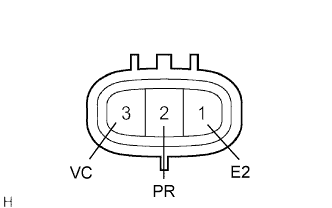 |
Disconnect the F9 sensor connector.
Measure the resistance of the sensor.
| Tester Connection | Specified Condition |
| 1 (E2) - 2 (PR) | 3 kΩ or less |
| 2 (PR) - 3 (VC) | 16.4 kΩ or less |
|
| ||||
| OK | ||
| ||
| ||


