Dyno Cell: Mitsubishi Galant
4G63 Power Tuning: Part 5
By Staff
It's
time to step up in the turbo department. So far, the 4G63 in Doug's
Dynopower's Galant VR-4 has performed admirably and made impressive
numbers through the first four installments of this "Dyno Cell" saga.
Most
of the time, enthusiasts go big and expect a bigger turbo to deliver
the big power numbers on its own. However, most don't understand the
relationship between components plays a role in making an engine run
well. A huge Garrett turbo is great for power potential, but without
the supporting hardware and tuning, it just looks pretty.
Another
issue with Garrett turbos is there are so many choices. Unlike
Mitsubishi turbochargers, which are only available in specific sizes,
Garrett turbos can span many "families" as hybrids. Further, there are
more wheel and housing choices on the Garrett side. To novices, this
can complicate things. But for knowledgeable enthusiasts and tuners,
these choices mean a much more optimized turbo can be selected.
The
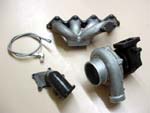
most popular Garrett unit for the 4G63 is the T3/T4 hybrid, especially
since a new cast-iron manifold complete with an external wastegate port
is now offered for these engines. This set-up uses a custom O2 housing
that adapts to the car's downpipe.
Doug's
Dynopower (DDP) tried three different units on the Galant before
deciding on the one currently in use. Doug's Dynopower used its own
Stage 1, 2 and 3 versions it offers in kit configuration. For our
article, Doug's Dynopower (DDP) bolted on its Stage 2 turbo.
The
first thing noticed at Doug's Dynopower was slower boost response
compared with the 16g. In this case, the company opted for the
ball-bearing option to promote a faster spool-up and increase the
durability of the turbo's bearing cartridge. Whereas the 16g would be
boosting well past 10 psi at 2800 rpm, the Garrett is at a leisurely 5
psi. However, the difference in airflow is so substantial that 5 psi
from the Garrett moves the car along as well as, if not better than, 10
psi did with the previous system--the previous pressure vs. volume
axiom.
Another
point of interest is the wastegate. An external gate keeps more precise
control of the boost level, and only opens when it needs to do its job.
An internal or integral gate tends to open with the exhaust pressure in
the turbine housing, which slows boost response.
The
T3/T4 hybrid turbo and its external wastegate were installed and the
car was driven on the street for some time to tune the fuel system and
timing. Then it was time to dyno the new combination. Starting at 15
psi, the 4G63 pumped out more than 355 hp. In comparison, the 16g had
to be at 19 psi to make numbers in the 340-hp range.
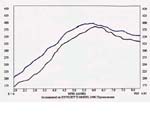
Upping
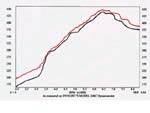
the Garrett to 18 psi netted 378.1 hp and 391.7 lb-ft of torque. While
low-end power and torque fell off slightly, the engine revved more
quickly with the Garrett on the job. So much so that the stock rev
limiter was hit much too easily. Luckily, DDP had a TMO-tuned ECU in
the car with an 8500 rev limit for this test.
Driving
the car is a night-and-day difference when compared with a stock car or
one with a smaller upgraded turbo. The power is smooth with the T3/T4,
lacking a surge or spike of torque between 3500 to 4000 rpm. Instead,
the engine pulls seamlessly to 7500 rpm and above.
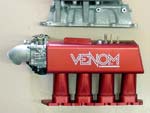
Since
the engine is ingesting a great deal more air, testing a higher flowing
intake manifold should reap benefits. A Venom unit was selected because
of its build quality and reasonable fitment. On the 4G63, this manifold
is not an R&R install. The stock coil needed to be moved and a
bracket fabricated. An intercooler pipe had to be moved as well.
Now
you'd think low-rpm response and power would suffer with the intake
installed. However, this was not the case. Once the engine reached 4000
rpm, it would shoot to 7000-plus rapidly when accelerating under boost.
Basically, it behaved like a motorcycle engine. Top-end power was
different as well. The engine didn't have a bottleneck at higher engine
speeds, which normally results in a drop-off on the power curve.
Instead, the 4G63 would pull very hard until you let off. The torque
curve was fairly flat in the mid-range and increased sizably above 7000
rpm.
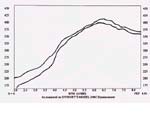
With
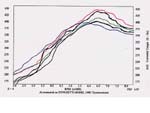
boost still set at 18 psi, peak output increased to a best of 397.3 hp
and 412.8 lb-ft of torque. The Crower cams from the last installment
complement the intake manifold and turbo set-up. They all scream
"mega-flow" and are further testimony to the importance of properly
matched parts.
Nitrous
oxide, the chemical supercharger, is a popular avenue for enthusiasts
on a budget or those with non-mainstream vehicles that lack the
aftermarket support Honda gets. In the ranks of some enthusiasts, most
notably Supra and Buick Grand National fans, adding nitrous to a
turbocharged car can be seen as akin to cheating. Some will be more
accepting of nitrous in the form of a spool-up system designed to come
on at WOT and shut off at a pre-described boost level.
An
oft-overlooked byproduct of a nitrous system is the cooling effect the
gas has on the incoming charge air. Plus, the stuff makes power. Doug's
Dynopower wanted more power and beyond upping the boost, nitrous was
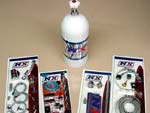
pretty much the last option left. A single-nozzle set-up from Nitrous
Express was plumbing into the 4G63.
Beyond
the expected parts, the Nitrous Express kit included a bottle heater,
gauge and purge valve and a "low fuel pressure" shut-off switch.
Installation was straightforward and Doug's Dynopower used a mild 35-hp
jetting strategy. The 4G63 engine responds well to laughing gas,
especially in small doses. With no other changes, the engine generated
436.7 hp and 447.6 lb-ft of torque while on the squeeze.
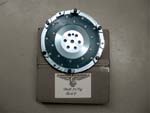
Prior
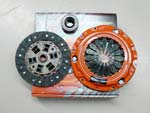
to any of the Part 5 add-ons, the clutch on the car was swapped. It had
a tendency to slip with the 16g and Doug's Dynopower knew an upgraded
turbo and adding the juice would push it too far. Doug's Dynopower
installed a new Centerforce Dual-Friction clutch along with a Fidenza
aluminum flywheel and logged 500 miles of break-in time before dynoing
the Garrett turbo system.
The
4G63 DSMs are among the most eager cars in the sport compact scene.
It's no secret the potential of the engine easily out-distances the
potential of the driveline. The clutch is like a fuse; it's designed to
give out in lieu of any hard parts in the driveline. As the clutch's
capacity is increased, the impact on the driveline is increased. The
trick is getting a clutch strong enough to put the power down, yet not
break transmissions, transfer cases, axles, rear differentials and so
on.
When
addressing the clutch, it's good to consider a lightened flywheel.
Impressed with the materials and quality of the new Fidenza units,
Doug's Dynopower just had to try one. Unfortunately, Doug's Dynopower
never made separate dyno runs with the clutch/stock flywheel and
clutch/Fidenza combo. The new unit is vastly lighter than the stocker
by more than 10 lbs and Doug's Dynopower could tell the engine revved
quicker with it.
For
now, the stock transmission is holding up fine. Doug's Dynopower
intends to get it rebuilt with stronger shift forks, synchros, and a
four-spider-gear center differential.
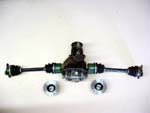
The
only other weak link is the rear differential and axles. The Galant
comes with a three-bolt rear end. The axle caps are attached with three
bolts, and the axles are small in diameter. In fact, the axles are
smaller than a 1992 to '94 AWD DSM rear end assembly.
The
Galant also has four-wheel steering and since the pump is attached to
the rear differential on the Galant, Doug's Dynopower opted to remove
it all. This resulted in a weight savings of roughly 45 lbs. A decent
used four-bolt rear end now sits there and it will stand up better to
power and future drag strip testing.
Now
what's in the cards for the Galant? Doug's Dynopower will try larger
nitrous jets and possibly a larger turbo, along with a ported, SS-valve
head. These proposed mods will pretty much exhaust our bolt-on efforts.
Stay tuned.
|
Power Realization Chart Round 1 Modifications
|
| | Hp | Tq | Gain Hp | Gain Tq |
| Baseline | 190.6 | 198.2 | -- | -- |
| K&N Filter | 201.8 | 220.3 | 11.2 | 22.1 |
| DDP Exhaust | 215.5 | 243.6 | 13.7 | 23.3 |
| DDP Downpipe | 220.7 | 254.1 | 5.2 | 10.5 |
| Total Gain | -- | -- | 30.1 | 55.9 |
|
Power Realization Chart Round 2 Modifications
|
| | Hp | Tq | Gain Hp | Gain Tq |
| Previous Power | 220.7 | 54.1 | -- | -- |
| Spearco Intercooler | 251.3 | 286.4 | 30.6 | 32.3 |
| DDP Cat | 259.9 | 304.1 | 8.6 | 17.7/td> |
| TeamRip Mass Air | 271.5 | 302.7 | 11.6 | -14 |
| Total Gain | -- | -- | 50.8 | 48.6 |
|
Power Realization Chart Round 3 Modifications
|
| | Hp | Tq | Gain Hp | Gain Tq |
| Previous Power | 271.5 | 302.7 | -- | -- |
| TD05-16g turbo | 299.1 | 322.4 | 27.6 | 19.7 |
| APEXi AFC | 307.2 | 334.6 | 8.1 | 12.2 |
| Turbo XS HPBC | 319.8 | 348.7 | 12.6 | 14.1 |
| Total Gain | -- | --48.3 | 46.0 |
Power Realization Chart Round 4 Modifications
16G turbo at 19 psi
|
| | Hp | Tq | Gain Hp | Gain Tq |
| Previous Power | 319.8 | 348.7 | -- | -- |
| RC Injectors | 327.2 | 354.6 | 7.4 | 5.9 |
| Crower Cams | 339.3 | 367.8 | 12.1 | 13.2 |
| Crane Ignition | 342.4 | 371.5 | 3.1 | 3.7 |
| Total Gain | -- | -- | 22.6 | 22.8 |
|
Power Realization Chart Round 5 Modifications
|
| | Hp | Tq | Gain Hp | Gain Tq |
| Previous Power | 342.4 | 371.5 | -- | -- |
| Garrett T3/T4 (15psi) | 355.2 | n/a | 12.8 | -- |
| Garrett T3/T4 (18psi) | 378.1 | 391.7 | 22.9 | 20.2 |
| Venom Intake | 397.3 | 412.8 | 19.2 | 21.1 |
| Nitrous Express | 436.7 | 447.6 | 39.4 | 34.8 |
| Total Gain | -- | -- | 94.3 | 76.1 |
|
Sources
|
Centerforce
(928) 771-8422
www.centerforce.com
Doug's Dynopower
(702) 616-6081
Fidenza Engineering Corp.
(440) 259-5656
Nitrous Express
(940) 767-7694
Python Injection (Venom Racing)
(714) 828-1406
|
|