|
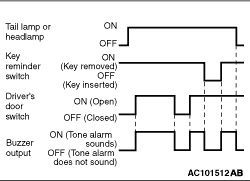
When the ignition key is removed and then the driver’s door is opened with turning ON the tail lamp or the head lamp, the buzzer sounds continuously to warn the driver that the lamp remains ON.
|
|
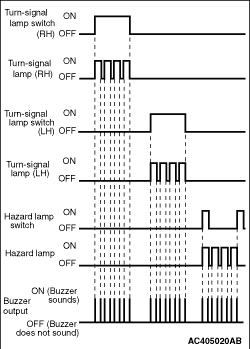
ETACS-ECU buzzer sounds simultaneously with the blinks of the turn-signal lamp and the hazard lamp.
|
|
|
If the driver turns the ignition switch to the "ON" position without fastening the seat belt, the ETACS-ECU sounds the buzzer and the combination meter illuminates the indicator to warn the driver to fasten the seat belt.
|
|
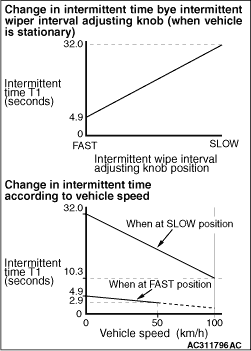
- ETACS-ECU calculates the intermittent time T1 based on the variable intermittent wiper volume switch signal sent from the column switch, and on the vehicle speed signal sent from the combination meter through CAN communication.
| note |
When the variable intermittent wiper volume switch is set at FAST position, the windshield wiper continuously operates at low speed instead of operating in an intermittent mode whenever the vehicle speed exceeds 50 km/h.
|
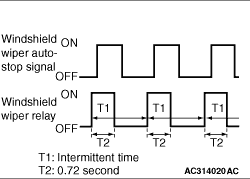
- When ETACS-ECU receives the windshield intermittent wiper switch ON signal from the column switch while the ignition switch is in the ACC or ON position, it turns the windshield wiper relay ON to operate the windshield wiper at low speed.
- When the windshield wiper comes to the stop position, the windshield wiper auto stop signal turns OFF. And the windshield wiper stops operating.
- When the intermittent time T1 has elapsed after the windshield wiper relay was turned ON, ETACS-ECU turns ON the windshield wiper relay again and repeats the procedure above.
| note |
Using a customise function, the calculation method of the intermittent time T1 can be configured.
|
|
|
|
The ETACS-ECU operates the windshield wipers according to the wiper request signal from the rain light sensor when the vehicle is driven with the windshield wiper switch in the "INT" position.
|
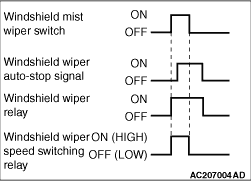
|
When the windshield mist wiper switch of the column switch is turned ON with the ignition switch in the ACC or ON position, ETACS-ECU turns ON the windshield wiper drive signal. At the same time, the wiper speed switch relay turns to ON (HI). And the windshield wiper operates at the high speed.
|
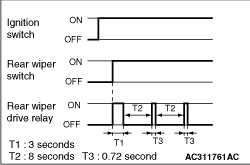
|
When the rear wiper switch on the column switch is turned ON with the ignition switch at the ACC or ON position, ETACS-ECU turns ON the rear wiper drive signal for 3 seconds (approximately 2 operations), and performs the intermittent action with 8 seconds intervals.
| note |
Using a customise function, the rear wiper intermittent operation time can be configured.
|
|
|
|
The ETACS-ECU outputs the high-beam indicator ON signal to the combination meter through CAN communication in synchronization with the high-beam headlamp operation. The combination meter receives the transmitted signal and turns ON or OFF the high-beam indicator.
|
|
|
When the ignition switch is turned to the "ON" position even while the headlamp switch is in the "OFF" position, the ETACS-ECU illuminates the tail lamp and headlamp (Lo-beam).
|
|
|
When the lighting switch is at the "AUTO" position, the ETACS-ECU illuminates the low-beam headlamps or the tail lamps according to the signal from the rain light sensor. Since the rain light sensor can judge the surrounding brightness and the brightness in front of the vehicle, it can illuminate the headlamps in advance when the vehicle enters a tunnel. However, the auto lamp does not work in a place where it gets dark momentarily like under a bridge.
|
|
|
When the passing switch is turned ON within 60 seconds after the ignition switch was turned to the OFF position, the coming home light (tail lamp and headlamp (Lo-beam) illuminate) operates for 30 seconds. While the coming home light is operated, if the passing, tail lamp, or headlamp (Lo-beam) switch is operated, the operation of the coming home light stops.
|
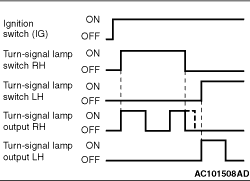
|
When the turn-signal lamp switch is ON (LH or RH) with the ignition switch ON, the turn-signal lamp output (flash signal) is turned ON.
If the lamp bulb of the front or rear turn-signal lamp has burned out, the flashing speed becomes faster to alert the driver that the lamp bulb has burned out.
|
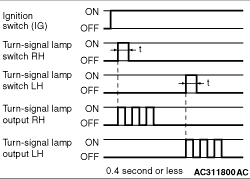
|
When the turn-signal lamp switch is turned ON momentarily (0.4 second or less) while the ignition switch is in the "ON" position, the turn-signal lamp (selected side) flashes 3 times.
| note |
Using a customise function, the comfort flashing function can be enabled or disabled and the operating conditions of the function can be configured.
|
|
|
|
ETACS-ECU outputs the turn-signal lamp indicator ON signal through CAN communication in synchronization with the turn signal lamp illumination. The combination meter receives the transmitted signal and turns ON or OFF the turn-signal lamp indicator.
|
|
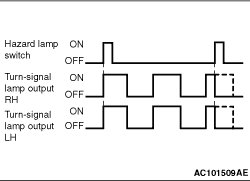
When the hazard lamp switch input signal turning from OFF to ON is detected, the flashing states turns over by the signal (When the hazard lamp is not blinking, it blinks. If it is blinking, it turns off).
| note |
- The push-return switch is adopted for the hazard lamp switch.
- Even if the lamp bulb has burned out, the flashing speed of the hazard lamp is not changed.
|
|
|
|
When the ETACS-ECU receives the ESS activation request signal from the ABS-ECU <Vehicles without active stability control system> or the TCL/ASC-ECU <Vehicles with active stability control system>, it flashes the turn-signal lamps at high speed to inform the following car that the driver is applying the brake suddenly.
|
|
|
ETACS-ECU outputs the front fog lamp indicator ON signal to the combination meter through CAN communication in synchronization with the front fog lamp illumination. The combination meter receives the signal sent from ETACS-ECU and turns the front fog lamp indicator ON and OFF.
|
|
|
ETACS-ECU outputs the rear fog lamp indicator ON signal to the combination meter through CAN communication in synchronization with the rear fog lamp illumination. The combination meter receives the transmitted signal and turns ON or OFF the rear fog lamp indicator.
|
)
)
)
)
)
)
)
)
)
)
)
)
)
)
)