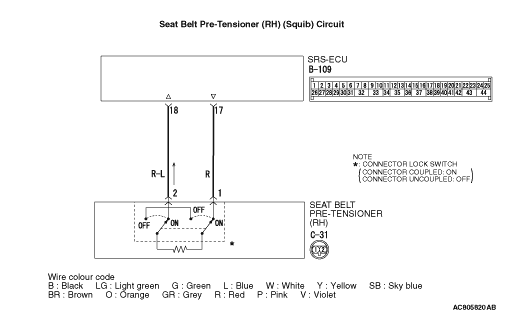
Code No.B1461: Seat belt pre-tensioner (RH) (squib) system (open- circuited in the squib circuit)
| caution |
If diagnosis code B1461 is set in the SRS-ECU, always diagnose the CAN main bus line.
|
OPERATION
The SRS-ECU judges how severe a collision is by detecting signals from the front air bag analogue G-sensor. If the impact is over a predetermined level, the SRS-ECU sends an ignition signal. At this time, if the front air bag safing G-sensor is on, the pre-tensioner will deploy.
DIAGNOSIS CODE SET CONDITIONS
This diagnosis code is set if there is abnormal resistance between the input terminals of the seat belt pre-tensioner (RH) (squib).
PROBABLE CAUSES
- Open circuit in the seat belt pre-tensioner (RH) (squib) circuit
- Improper connector contact
- Malfunction of the SRS-ECU
|
|
STEP 1. M.U.T.-III CAN bus diagnostics.
|
|
|
| warning |
Since the radiator fan rotates during CAN bus line diagnostics, make sure that no one is servicing the engine compartment before diagnosing the CAN bus line. Since the CAN communication stops when diagnosing the CAN bus line, the ETACS-ECU detects the time-out of the engine-ECU, and activates the radiator fan to prevent overheating as fail-safe.
|
|
|
|
Use the M.U.T.-III to check the CAN bus lines.
|
|
|
Q.
Is the CAN bus line found to be normal?
|
|
|
 Go to Step 2. Go to Step 2.
|
|
|
|
|
|
 Repair the CAN bus line (Refer to GROUP 54C, Troubleshooting - Can Bus Diagnosis Table Repair the CAN bus line (Refer to GROUP 54C, Troubleshooting - Can Bus Diagnosis Table  ). ).
|
|
|
|
|
|
STEP 2. Check whether the diagnosis code is reset.
|
|
|
Check again if the diagnosis code is set.
|
|
|
(1)Erase the diagnosis code.
|
|
|
(2)Turn the ignition switch to "ON" position.
|
|
|
(3)Check if the diagnosis code is set.
|
|
|
(4)Turn the ignition switch to the "LOCK" (OFF) position.
|
|
|
Q.
Is the diagnosis code set?
|
|
|
Go to Step 3.
|
|
|
|
|
|
There is an intermittent malfunction such as poor engaged connector(s) or open circuit (Refer to GROUP 00, How to Cope with Intermittent Malfunction ).
|
|
|
|
|
|
STEP 3. Check the seat belt pre-tensioner (RH) (M.U.T.-III diagnosis code).
|
|
|
(1)Disconnect the negative battery terminal.
|
|
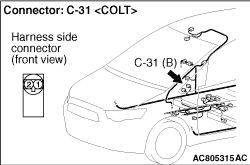
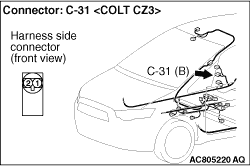
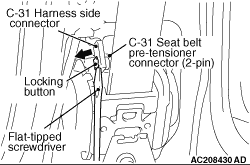
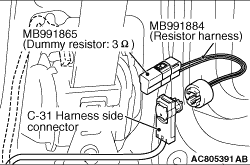
(2)Use a flat-tipped screwdriver to pull out forward and unlock the locking button of the harness side connector, and then disconnect seat belt pre-tensioner connector (RH) C-31.
|
|
(3)Connect special tool dummy resistor (MB991865) to special tool resistor harness (MB991884).
(4)Connect special tool resistor harness (MB991884) to the C-31 harness side connector.
(5)Connect the negative battery terminal.
(6)Erase diagnosis code memory, and then check the diagnosis code.
Q.
Is diagnosis code B1461 set?
Go to Step 4.
Replace the seat belt with pre-tensioner (RH) (Refer to ). Then go to Step 5.
|
|
|
STEP 4. Resistance measurement between the SRS-ECU connector B-109 (terminal No.17 and 18) and the seat belt pre-tensioner (RH) connector C-31 (terminal No.1 and 2).
|
|
|
(1)Disconnect the negative battery terminal.
|
|
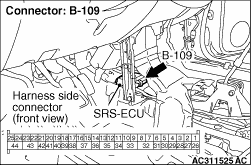
(2)Disconnect seat belt pre-tensioner (RH) connector C-31. For connector C-31, use a flat-tipped screwdriver to pull out forward and unlock the locking button of the harness side connector, and then disconnect the connector.
|
|
(3)Disconnect SRS-ECU connector B-109.
|
|
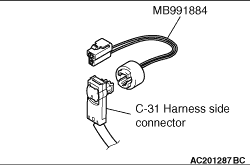
(4)Connect C-31 harness side connector to special tool resistor harness (MB991884).
|
|
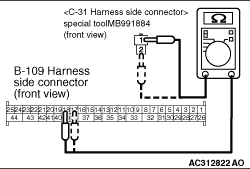
(5)Resistance at measurement between the following terminals.
- SRS-ECU connector B-109 (terminal No.17) and the special tool (terminal No.2)
- SRS-ECU connector B-109 (terminal No.18) and the special tool (terminal No.1)
OK: Continuity (less than 2 Ω)
Q.
Are the check results normal?
Go to Step 5.
Repair the harness wires between SRS-ECU connector B-109 (terminal No.17 and 18) seat belt pre-tensioner connector (RH) C-31 (terminal No.1 and No.2).
|
|
|
STEP 5.Check whether the diagnosis code is reset.
|
|
|
Q.
Is diagnosis code B1461 set?
|
|
|
Replace the SRS-ECU (Refer to ).
|
|
|
|
|
|
An intermittent malfunction is suspected (Refer to GROUP 00, How to Cope with Intermittent Malfunction ).
|
|
|
|
)
)
)
)
)
)
)
)