|
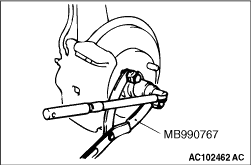
Use special tool front hub and flange yoke holder (MB990767) to fix the hub and remove
the driveshaft nut.
|
|
| caution |
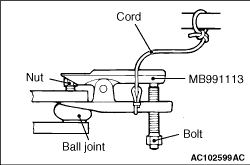
- Do not remove the nut from ball joint. Loosen it and use special
tool to avoid possible damage to ball joint threads.
- Hang special tool with cord to prevent it from falling.
Replace the self-locking nut with a regular nut, and then install special tool steering
linkage puller (MB991113) as shown in the figure.
|
|
|
1.
| caution |
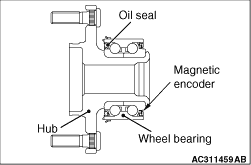
- The magnetic encoder collects any metallic particle easily, because it is magnetized.
Make sure that the magnetic encoder does not collect any metallic particle.
- When the driveshaft is removed, make sure that it does not contact with the magnetic
encoder and front wheel speed sensor to avoid damage.
|
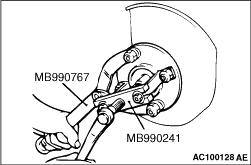
Use the following special tools to push out the driveshaft or the driveshaft and inner
shaft assembly from the hub.
- Front hub and flange yoke holder (MB990767)
- Axle shaft puller (MB990241)
|
|
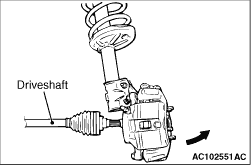
2.Remove the driveshaft from the hub by pulling the bottom of the brake disc towards you.
|
|
3.
| caution |
- Do not pull on the driveshaft; doing so
will damage the TJ; be sure to use the pry bar.
- When pulling the driveshaft out from the transmission, be careful that the spline
part of the driveshaft does not damage the oil seal.
|
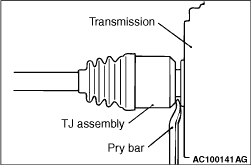
Insert a pry bar between the transmission case and the driveshaft, and then pry and remove
the driveshaft from the transmission.
| note |
For vehicles with petrol engine 4G1 and diesel engine, it is not necessary to use a pry
bar in removal of the driveshaft (RH).
|
|
|
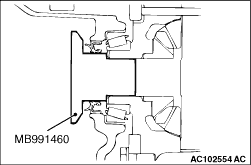
4.Use special tool plug (MB991460) to prevent the entry of foreign material into the transmission
case.
|
|
| caution |
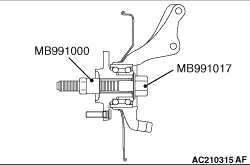
Do not apply pressure to the wheel bearing by the vehicle weight to avoid possible damage
when the driveshaft is removed. If, however, vehicle weight must be applied to the bearing in
moving the vehicle, temporarily secure the wheel bearing by using the following special tools.
- Spacer (MB991000)
- Front hub remover and installer (MB991017)
|
|
|
| caution |
- The magnetic encoder collects any metallic particle easily, because it is magnetized.
Make sure that the magnetic encoder should not collect any metallic particle. Check that there
is not any trouble prior to reassembling it.
- When the driveshaft is installed, make sure that it does not contact with the magnetic
encoder and front wheel speed sensor to avoid damage.
- When installing the driveshaft, be careful that the driveshaft does not damage the
oil seal.
|
|
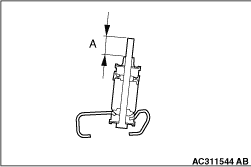
|
Install the stabilizer link bush (B) assembly, stabilizer link inner bush and stabilizer
link bush (A) as shown in the figure, and tighten the stabilizer link bush (A) so that the protruding
length of the stabilizer link bush (B) assembly meets its standard value (A).
Standard value (A): 22 ± 1.5 mm
|
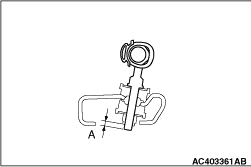
|
Install the stabilizer link bush (B), stabilizer link assembly and stabilizer link bush
(A) as shown in the figure, and tighten the stabilizer link bush (A) so that the protruding
length of the stabilizer link assembly meets its standard value (A).
Standard value (A): 5 ± 1.5 mm
|
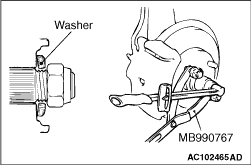
|
1.Be sure to install the driveshaft washer in the specified direction.
2.
| caution |
Before securely tightening the driveshaft nuts, make
sure there is no load on the wheel bearings. Otherwise the wheel bearing will be damaged.
|
Using special tool front hub and flange yoke holder (MB990767), tighten the new driveshaft
nut to the specified torque.
Tightening torque: 236 ± 19 N·m
|
 ,
, )
)
)
)
)
)
)
)
)
)
)
)
)