CRANKCASE VENTILATION
SYSTEM
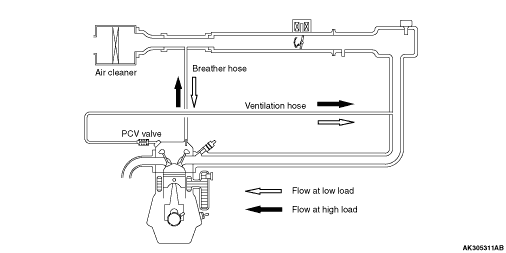
The crankcase ventilation system prevents the blowby gas from being released into the atmosphere.
It consists of a ventilation hose that leads the blowby gas from the cylinder head cover to the
inlet manifold, a positive crankcase ventilation (PCV) valve that controls the blowby gas, and
a breather hose that leads air from the air intake hose to the cylinder head cover.
When the engine is running at low-load conditions, the inlet manifold vacuum causes the crankcase
blowby gas to pass from the cylinder head cover to the PCV valve and the ventilation hose and be
drawn into the inlet manifold, thus creating a vacuum in the crankcase. Along with this process, fresh
air passes from the air intake hose to the breather hose and the cylinder head cover, and enters
the crankcase.
When the engine is running under high-speed, high-load conditions (also, the throttle
valve is not opened fully), the blowby gas in the crankcase passes through the cylinder head
cover, PCV valve, and the ventilation hose, and enters the inlet manifold. At the same time,
the vacuum in the air intake hose draws the blowby gas from the breather hose into the inlet
manifold, via the throttle valve.
PCV VALVE
The PCV valve controls the intake amount of the blowby gas in accordance with the inlet
manifold vacuum. Therefore, under low-load conditions, this valve restricts the blowby intake
amount in order to ensure the stability of the engine. The amount of the intake blowby gas also
increases as the load becomes high. However, the amount of the intake blowby gas decreases because
the inlet manifold pressure becomes to be closer to the atmospheric pressure as the throttle
valve opens more fully.
)