|
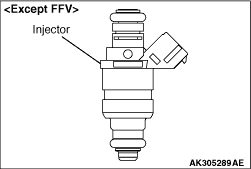
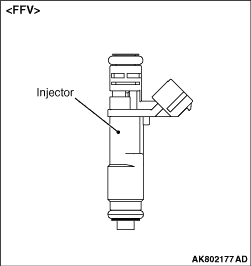
The injectors inject fuel in accordance with the actuation signals provided by the engine-ECU
or engine-A-M/T-ECU. The fuel injection volume is controlled by the engine-ECU or engine-A-M/T-ECU
in accordance with the signals provided by the crank angle sensor and the manifold absolute
pressure sensor. One injector is provided for each cylinder, and the injectors are mounted on
the cylinder head.
The delivery pipes deliver fuel to the injectors.
The nozzle of an injector contains 8 injection orifices that enable the injector to inject
atomize fuel towards the two intake valves that are provided for each cylinder. This improves combustion
efficiency and reduces the amount of HC (hydrocarbon) emissions when the engine is cold.
|
|
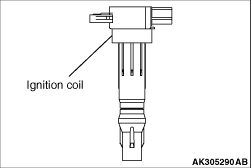
The ignition coils generate high voltage that is required for igniting the spark plugs
in accordance with the ignition signals provided by the engine-ECU or engine-A-M/T-ECU.
The engine-ECU or engine-A-M/T-ECU controls the ignition timing in accordance with the
signals provided by the crank angle sensor and the manifold absolute pressure sensor.
An ignition coil, which is the plug-on type with a built-in power transistor, is provided
for each cylinder, thus constituting an independent injection system. This system enables the ignition
energy generated by the ignition coil to be supplied efficiently to the spark plug.
|
|
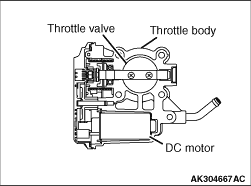
The throttle valve control servo, which is built into the throttle body, opens and closes
the throttle valve in accordance with the signals provided by the engine-ECU or engine-A-M/T-ECU.
The engine-ECU or engine-A-M/T-ECU determines the extent of the opening of the throttle valve
in accordance with the signals provided by the crank angle sensor and the accelerator pedal position
sensor, and controls the direction of current applied to the motor and its amperage.
The throttle valve control servo has adopted a highly responsive and energy efficient
DC motor that uses small brushes.
The throttle valve holds its predetermined position when no current is applied to the
throttle valve control servo. Thus, even if the current is disrupted due to a system malfunction, this
system ensures the vehicle to be driven at a minimum level.
|
)
)
)
)
)