|
|
1.Release residual pressure from the fuel pipe line to prevent fuel gush out (Refer
to  ). ).
| caution |
Cover the hose connection with rags to prevent splash of fuel
that could be caused by some residual pressure in the fuel pipe line.
|
|
|
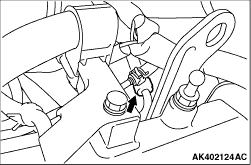
2.Disconnect the high-pressure fuel hose at the delivery pipe side.
|
|
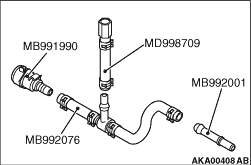
3.Assemble the special tool Injector test set (MD998706 or MB992076) of special tool as
shown in figure.
(1)
Remove the injector installation adapter from the hose. Remove another hose together
with the adapter and remove the adopter from the remaining hose.
(2)
Install the special tool quick connector (MB991990) and the special tool hose adapter
(MB992001) to the hose without the adopter.
(3)
Remove the nipple of the bolt of the special tool hose adapter (MD998709).
(4)
Install the special tool prepared in the procedure (3) to the nipple that was removed
together with hose in the procedure (1)
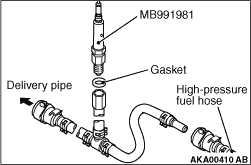
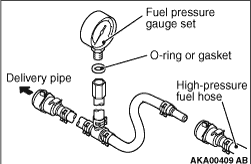
4.Assemble the fuel pressure measurement tools as follows.
|
|
<When using the fuel pressure gauge set (special
tool) >
- Via a gasket, install the special tool fuel pressure gauge set (MB991637 or MB991981)
into the special tool that has already assembled as described.
|
|
<When using the fuel pressure gauge>
- Via a suitable O-ring or gasket, install the fuel pressure gauge to the special
tool that has already assembled as described.
5.Install the assembled fuel pressure measurement tools between the delivery pipe and
fuel high-pressure hose.
| caution |
To prevent damage to the M.U.T.-III, always
turn the ignition switch to the "LOCK" (OFF) position before connecting or disconnecting the
M.U.T.-III.
|
6.Connect the M.U.T.-III to the diagnosis connector.
7.Turn the ignition switch to "ON" position (But do not start the engine).
8.Select "Item No. 5" from the M.U.T.-III Actuator test to drive the fuel pump. Check
that there are no fuel leaks from any parts.
9.Finish the actuator test or turn the ignition switch to "LOCK" (OFF) position.
10.Start the engine and run at idle.
11.Measure fuel pressure while the engine is running at idle.
Standard value: Approximately 230 kPa at curb idle
|
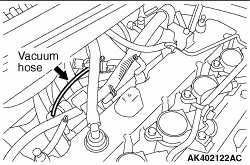
|
12.Disconnect the vacuum hose from the fuel pressure regulator and measure fuel pressure
with the hose end closed by a finger.
Standard value: 289 - 309 kPa at curb idle
13.Check to see that fuel pressure at idle does not drop even after the engine has been
raced several times.
14.Racing the engine repeatedly, hold the fuel return hose lightly with fingers to feel
that fuel pressure is present in the return hose.
| note |
If the fuel flow rate is low, there will be no fuel pressure in the return hose.
|
15.If any of fuel pressure measured in steps 11 to 14 is out of specification, troubleshoot
and repair according to the table below.
Symptom
|
Probable cause
|
Remedy
|
- Fuel pressure too
low
- Fuel pressure drops after racing
- No fuel pressure in fuel return hose
|
Clogged fuel filter
|
Replace fuel filter
|
Fuel leaking to return side due to poor fuel regulator valve seating
or settled spring
|
Replace fuel pressure regulator
|
Low fuel pump delivery pressure
|
Replace fuel pump
|
Fuel pressure too high
|
Binding valve in fuel pressure regulator
|
Replace fuel pressure regulator
|
Clogged fuel return hose or pipe
|
Clean or replace hose or pipe
|
Same fuel pressure when vacuum hose is connected and when disconnected
|
Damaged vacuum hose or clogged nipple
|
Replace vacuum hose or clean nipple
|
16.Stop the engine and check change of fuel pressure gauge reading. Normal if the reading
does not drop within 2 minutes. If it does, observe the rate of drop and troubleshoot and repair
according to the table below.
Symptom
|
Probable cause
|
Remedy
|
Fuel pressure drops gradually after engine is stopped
|
Leaky injector
|
Replace injector
|
Leaky fuel regulator valve seat
|
Replace fuel pressure regulator
|
Fuel pressure drops sharply immediately after engine is stopped
|
Check valve in fuel pump is held open
|
Replace fuel pump
|
17.Release residual pressure from the fuel pipe line (Refer to ).
| caution |
Cover the hose connection with rags to prevent splash of fuel
that could be caused by some residual pressure in the fuel pipe line.
|
18.Remove the fuel pressure gauge and special tool from the delivery pipe.
19.Fit the fuel high pressure hose over the delivery pipe and tighten.
20.Check for any fuel leaks by following the procedure in step 7.
21.Disconnect the M.U.T.-III.
|
)
)
)
)
)