HOW TO USE THIS
MANUAL
SCOPE OF MAINTENANCE, REPAIR AND SERVICING EXPLANATIONS
This manual provides explanations, etc. concerning procedures for the inspection, maintenance,
repair and servicing of the subject model. Note, however, that for engine and transmission-related
component parts, this manual covers only on-vehicle inspections, adjustments, and the removal
and installation procedures for major components. For detailed information concerning the inspection, checking,
adjustment, disassembly and reassembly of the engine, transmission and major components after
they have been removed from the vehicle, please refer to separate manuals covering the engine
and the transmission.
ON-VEHICLE SERVICE
"On-vehicle Service" is procedures for performing inspections and adjustments of particularly
important locations with regard to the construction and for maintenance and servicing, but other
inspection (for looseness, play, cracking, damage, etc.) must also be performed.
INSPECTION
Under this title are presented inspection and checking procedures to be performed by using special
tools and measuring instruments and by feeling, but, for actual maintenance and servicing procedures,
visual inspections should always be performed as well.
DEFINITION OF TERMS
STANDARD VALUE
Indicates the value used as the standard for judging the quality of a part or assembly
on inspection or the value to which the part or assembly is corrected and adjusted. It is given
by tolerance.
LIMIT
Shows the standard for judging the quality of a part or assembly on inspection and means
the maximum or minimum value within which the part or assembly must be kept functionally or
in strength. It is a value established outside the range of standard value.
REFERENCE VALUE
Indicates the adjustment value prior to starting the work (presented in order to facilitate
assembly and adjustment procedures, and so they can be completed in a shorter time).
DANGER, WARNING, AND CAUTION
DANGER, WARNING, and CAUTION call special attention to a necessary action or to an action
that must be avoided. The differences among DANGER, WARNING, and CAUTION are as follows:
- If a DANGER is not followed, the result is severe bodily harm or even death.
- If a WARNING is not followed, the result could be bodily injury.
- If a CAUTION is not followed, the result could be damage to the vehicle, vehicle
components or service equipment.
TIGHTENING TORQUE INDICATION
Tightening torques (units: N·m) are set to take into account the central value
and the allowable tolerance. The central value is the target value, and the allowable tolerance
provides the checking range for tightening torques. If bolts and nuts are not provided with
tightening torques, refer to  .
.
MODEL INDICATIONS
The following abbreviations are used in this manual for identification of model types.
1100 Indicates models equipped with the 1,124 mL <134910 or 3A91> petrol engine.1300 Indicates models equipped with the 1,332 mL <135930 or 4A90> petrol engine.1500 Indicates models equipped with the 1,468 mL <4G15> petrol engine.A/C Indicates the air conditioner.2WDIndicates the 2-wheel drive vehicles.AS&G Indicates the Auto Stop and Go system.Clear TecIndicates the low CO2 type or low CO2 specification.COLT Indicates the 4-door hatchback.COLT CZ3 Indicates the 2-door hatchback.DOHC Indicates an engine with the double overhead camshaft.MIVEC Indicates Mitsubishi innovative valve timing electronic control system.MPI Indicates the multipoint injection.M/T Indicates the manual transmission.
EXPLANATION OF MANUAL CONTENTS
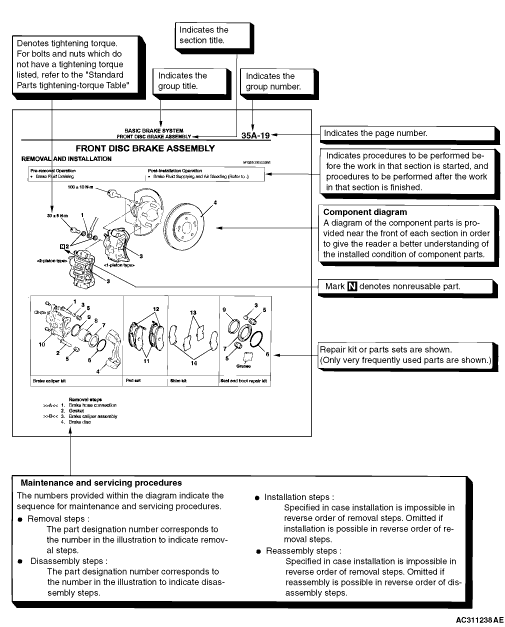
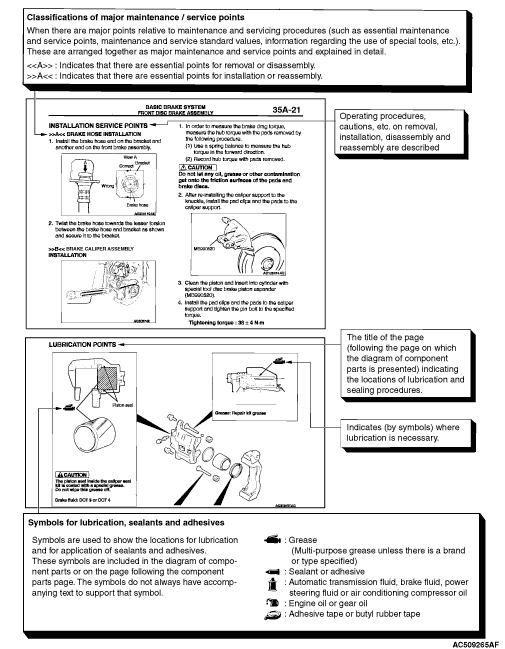
)
)