Development:
Developing for
the Palm OS requires a C compiler, a Palm OS SDK, and a UI resource compiler.
The
following details the tools being utilized to build MMCd:
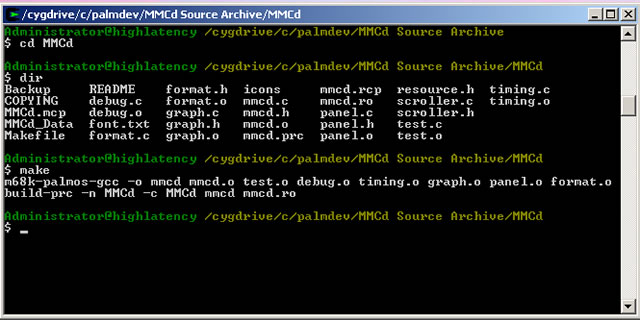
Cygwin:
Cygwin is a readily
available application that provides a unix emulation layer for windows based
systems. This allows PRC-Tools and PilRC to work on a windows machine and
eliminating the need to build the project under unix.
PRC-Tools:
The
following details tools used when coding and debugging MMCd:
Palm
Simulator:
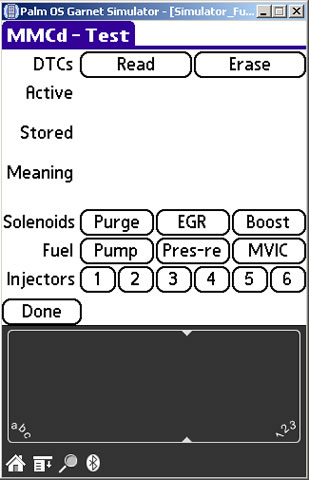
The Palm Simulator
is an application that is designed to simulate a Palm device on your desktop,
eliminating the need to transfer your .prc file to a Palm device in order
to test your application.
Microsoft
Visual Studio.NET:
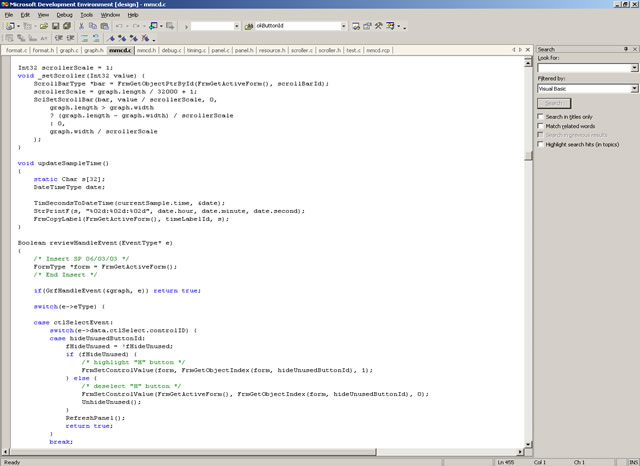
Visual Studio provides
a nice GUI for editing your code before compiling it utilizing the tools listed
above.
Falch.net
Developer Studio for Palm OS:
Just recently I stumbled upon
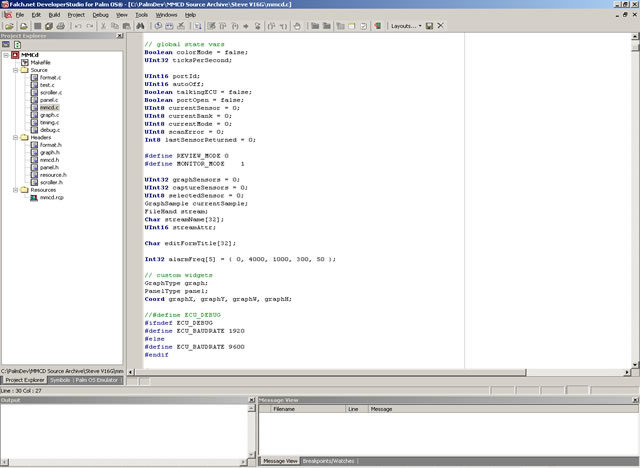
Falch.net Developer Studio for Palm OS, a graphical development application
that utilizes cygwin, PRC-Tools, and PiLRC while providing a graphical development
environment similar to Visual Studio. As of this writing Falch.net's website
appears to be having problems, but more information on the application can
be found by searching Google.