Piston Ring Replacement

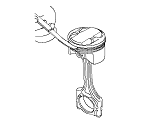
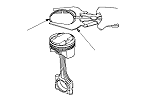
  1. Using a ring expander (A), remove the old piston rings (B).
  1. Clean all ring grooves thoroughly with a squared-off broken ring or ring groove cleaner with a blade to fit the piston grooves.
    The top and 2nd ring grooves are 1.2 mm (0.05 in.) wide. The oil ring groove is 2.0 mm (0.08 in.) wide.
    File down a blade if necessary.
    Do not use a wire brush to clean the ring grooves, or cut the ring grooves deeper with the cleaning tools.
    NOTE: If the piston is to be separated from the connecting rod, do not install the new rings yet.
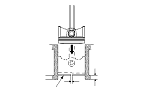
  1. Using a piston that has its rings removed, push a new ring (A) into the cylinder bore 15−20 mm (0.6−0.8 in.) from the bottom.
  1. Measure the piston ring end-gap (B) with a feeler gauge:
    Piston Ring End-Gap
    Top Ring:
    Standard (New):
    0.20−0.35 mm (0.008−0.014 in.)
    Service Limit:
    0.60 mm (0.024 in.)
    Second Ring:
    Standard (New):
    0.50−0.65 mm (0.020−0.026 in.)
    Service Limit:
    0.70 mm (0.028 in.)
    Oil Ring (RIKEN):
    Standard (New):
    0.20−0.50 mm (0.008−0.020 in.)
    Service Limit:
    0.55 mm (0.022 in.)
    Oil Ring (NIPPON PISTON RING):
    Standard (New):
    0.20−0.70 mm (0.008−0.028 in.)
    Service Limit:
    0.75 mm (0.030 in.)


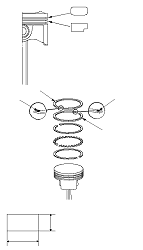
  1. Install the top ring and the second ring as shown. The top ring (A) has a 1R or 1N mark, and the second ring (B) has a 2RN or 2N mark. The manufacturing marks (C) must be face upward.
  1. Rotate the rings in their grooves to make sure they do not bind.

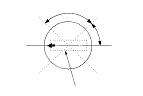
  1. Position the ring end gaps as shown:

  1. After installing a new set of rings, measure the ring-to-groove clearances:

    Top Ring Clearance

    Standard (New):
    0.060−0.085 mm (0.0024−0.0033 in.)
    Service Limit:
    0.13 mm (0.005 in.)


    Second Ring Clearance

    Standard (New):
    0.040−0.065 mm (0.0016−0.0026 in.)
    Service Limit:
    0.13 mm (0.005 in.)