Crankshaft Main Bearing Replacement
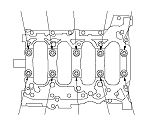
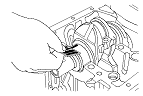
Main Bearing Clearance Inspection
  1. Clean each main journal and the bearing half with a clean shop towel.
  1. Place one strip of plastigage across each main journal.
  1. Reinstall the bearings and the lower block, then torque the bolts to 29 N·m (3.0 kgf·m, 22 lbf·ft).
    NOTE: Do not rotate the crankshaft during inspection.
  1. Tighten the bearing cap bolts an additional 48 °.

  1. Remove the lower block and the bearings again, and measure the widest part of the plastigage.
    Main Bearing-to-Journal Oil Clearance
    No. 1, 2, 4, 5 Journals:
    Standard (New):
    0.017 − 0.041 mm (0.0007 − 0.0016 in.)
    Service Limit:
    0.050 mm (0.0020 in.)
    No. 3 Journal:
    Standard (New):
    0.025 − 0.049 mm (0.0010 − 0.0019 in.)
    Service Limit:
    0.055 mm (0.0022 in.)


  1. If the plastigage measures too wide or too narrow, remove the crankshaft, and remove the upper half of the bearing. Install a new, complete bearing with the appropriate color code(s), and recheck the clearance. Do not file, shim, or scrape the bearings or the caps to adjust clearance.
  1. If the plastigage shows the clearance is still incorrect, try the next larger or smaller bearing (the color listed above or below the current one), and check clearance again. If the proper clearance cannot be obtained by using the appropriate larger or smaller bearings, replace the crankshaft and start over.

Main Bearing Selection
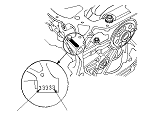
Crankshaft Bore Code Location
  1. Numbers, letters, or bars have been stamped on the end of the engine block as a code for the size of each of the five main journal bores. Write down the crank bore codes.
    If you can't read the codes because of accumulated dirt and dust, do not scrub them with a wire brush or scraper. Clean them only with solvent or detergent.

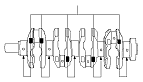
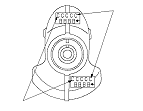
Main Journal Code Location
  1. The main journal codes are stamped on the crankshaft in either location.

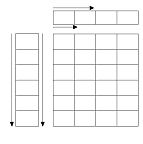
  1. Use the crank bore codes and crank journal codes to select the appropriate replacement bearings from the following table.
    NOTE:
    • The color code is on the edge of the bearing.
    • When using bearing halves of different colors, it does not matter which color is used in the top or bottom.