Piston Ring Replacement

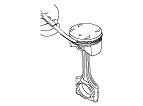
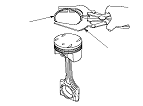
  1. Using a ring expander (A), remove the old piston rings (B).
  1. Clean all ring grooves thoroughly with a squared-off broken ring or ring groove cleaner with a blade to fit the piston grooves.
    The top and 2nd ring grooves are 1.2 mm (0.05 in.) wide. The oil ring groove is 2.0 mm (0.08 in.) wide.
    File down a blade if necessary.
    Do not use a wire brush to clean the ring grooves, or cut the ring grooves deeper with the cleaning tools.
    NOTE: If the piston is to be separated from the connecting rod, do not install the new rings yet.
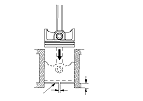
  1. Using a piston that has its rings removed, push a new ring (A) into the cylinder bore 15−20 mm (0.6−0.8 in.) from the bottom.
  1. Measure the piston ring end-gap (B) with a feeler gauge:

    Piston Ring End-Gap

    Top Ring:
    Standard (New):
    0.20−0.35 mm (0.008−0.014 in.)
    Service Limit:
    0.60 mm (0.024 in.)
    Standard (New):
    0.40−0.55 mm (0.016−0.022 in.)
    Service Limit:
    0.70 mm (0.028 in.)
    Standard (New):
    0.20−0.50 mm (0.008−0.020 in.)
    Service Limit:
    0.80 mm (0.031 in.)


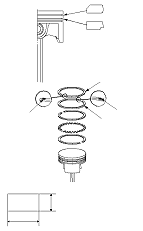
  1. Install the top ring and the second ring as shown. The top ring (A) has a 1R mark, and the second ring (B) has a 2R mark. The manufacturing marks (C) must face upward.
  1. Rotate the rings in their grooves to make sure they do not bind.

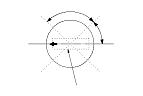
  1. Position the ring end gaps as shown:

  1. After installing a new set of rings, measure the ring-to-groove clearances:

    Top Ring Clearance

    Standard (New):
    0.045−0.070 mm (0.0018−0.0028 in.)
    Service Limit:
    0.13 mm (0.005 in.)


    Second Ring Clearance

    Standard (New):
    0.030−0.055 mm (0.0012−0.0022 in.)
    Service Limit:
    0.13 mm (0.005 in.)