Radiator Replacement

  1. Raise the vehicle on the lift to full height.
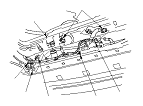
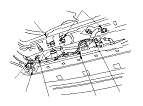
  1. Remove the lower radiator hose (A).
  1. A/T model: Remove the automatic transmission fluid (ATF) cooler hoses (B), then plug the hose and line.
  1. Disconnect the fan motor connectors (C) and engine coolant temperature (ECT) sensor 2 connector (D), then remove the harness clamps (E).
  1. Lower the vehicle on the lift.

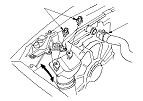
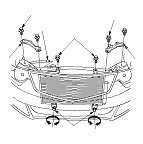
  1. Remove the clips (A) securing the intake air duct cover.
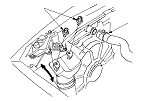
  1. Remove the upper radiator hose (B).

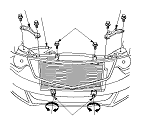
  1. Remove the coolant reservoir hose (A) and the radiator upper brackets (B).
  1. With A/C: Remove the A/C condenser upper mounting bolts (C) and loosen the A/C condenser lower mounting bolts (D).

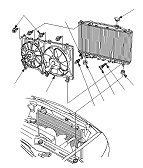
  1. Pull up the radiator, then remove the radiator fan shroud assembly (A), A/C condenser fan shroud assembly (B), radiator cap (C), ETC sensor 2 (D), and drain plug (E).
  1. Reassemble the radiator with new O-rings (F).
  1. Install the radiator. Make sure the lower cushions (G) are set securely.

  1. With A/C: Set the A/C condenser, then tighten the upper mounting bolts (A) and the A/C condenser lower mounting bolts (B).
  1. Install the coolant reservoir hose (C) and the radiator upper brackets (D).

  1. Install the upper radiator hose (A).
  1. Install the clips (B) securing the intake air duct cover.
  1. Raise the vehicle on the lift to full height.

  1. Connect the fan motor connectors (A) and ECT sensor 2 connector (B), then install the harness clamp (C).
  1. Install the lower radiator hose (D).
  1. A/T model: Install the ATF cooler hoses (E).
  1. Lower the vehicle on the lift.
  1. Clean up any spilled engine coolant.