-
-
Apply the parking brake, and block all four wheels.
-
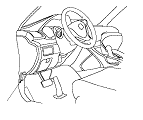
Connect the HDS to the DLC (A) located under the driver's side of the dashboard, and go to the A/T Data list.
-
-
Make sure the A/C switch is OFF.
-
After the engine has warmed up to normal operating temperature (the radiator fan comes on), shift the shift lever in D.
-
Firmly press the brake pedal, then press the accelerator pedal for 6 to 8 seconds, and note the engine speed. Do not move the shift lever while raising engine speed.
-
Allow 2 minutes for cooling, then repeat the test in D and R.
NOTE:
-
Do not test stall speed for more than 10 seconds at a time.
-
Stall speed tests should be used for diagnostic purposes only.
-
Stall speed tests should be the same in D and R.
-
Do not test stall speed with the A/T oil pressure gauges installed.
|
Stall Speed rpm
|
|
R20A3 Engine Model:
|
|
Specification:
|
2,150 rpm (min
−1
)
|
|
Service Limit:
|
2,000−2,300 rpm (min
−1
)
|
|
K24Z3 Engine Model:
|
|
Specification:
|
2,100 rpm (min
−1
)
|
|
Service Limit:
|
1,950−2,250 rpm (min
−1
)
|
-
If the stall speeds are out of the service limit, problems and probable causes are listed in the table.
|
Problem
|
Probable Causes
|
|
Stall speed rpm high in D and R
|
-
ATF pump output low
-
Clogged ATF strainer
-
Regulator valve stuck
-
Slipping clutch
|
|
Stall speed rpm high in R
|
Slippage 4th clutch
|
|
Stall speed rpm low in D and R
|
|
|
|