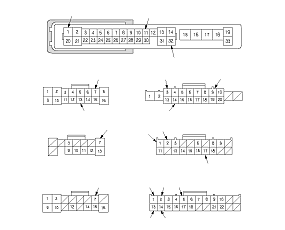
Turn Signal/Hazard Warning Lights (Driver's MICU) Input Test

Driver's MICU
NOTE: Before testing, check the No. 5 (7.5 A) fuse in the driver's under-dash fuse/relay box.
  1. Turn the ignition switch to LOCK (0).
  1. Disconnect driver's under-dash fuse/relay box connectors D, F, N, P, Q, and R.
    NOTE: All connector views are wire side of female terminals.
  1. Inspect the connector and socket terminals to be sure they are all making good contact.
    • If the terminals are bent, loose or corroded, repair them as necessary and recheck the system.
    • If the terminals look OK, go to Step 5 .
  1. With the connectors still disconnected, make these input tests at the appropriate connector.
    • If any test indicates a problem, find and correct the cause, then recheck the system.
    • If all the input tests prove OK, go to Step 6 .
    Cavity
    Wire
    Test condition
    Test: Desired result
    Possible cause if desired result is not obtained
    Q1
    BLK
    Under all conditions
    Check for continuity to ground: There should be continuity.
    • Poor ground (G502)
    • An open in the wire
    Q2
    BRN
    Under all conditions
    Check for continuity to ground: There should be continuity.
    • Poor ground (G501)
    • An open in the wire
    R2
    BRN
    Under all conditions
    Check for continuity to ground: There should be continuity.
    • Poor ground (G501)
    • An open in the wire
    R5
    BLK
    Under all conditions
    Check for continuity to ground: There should be continuity.
    • Poor ground (G502)
    • An open in the wire
    F11 [P9]
    WHT
    Under all conditions
    Measure the voltage to ground: There should be battery voltage.
    • Blown No. 15 (10 A) fuse in the under-hood fuse/relay box
    • Faulty passenger's fuse/relay box (RHD model)
    • An open in the wire
    F32
    WHT
    Under all conditions
    Measure the voltage to ground: There should be battery voltage.
    • Blown No. 9 (15 A) fuse in the under-hood fuse/relay box
    • An open in the wire
    D7
    GRN
    Ignition switch ON (II)
    Connect F32 and D7 terminals with a jumper wire:
    The right rear turn signal light should come on.
    • Poor ground (G901)
    • Blown bulb
    • An open in the wire
    D13
    BLU
    Ignition switch ON (II)
    Connect F32 and D13 terminals with a jumper wire:
    The left rear turn signal light should come on.
    • Poor ground (G901)
    • Blown bulb
    • An open in the wire
    F1
    BLU
    Ignition switch ON (II)
    Connect F32 and F1 terminals with a jumper wire:
    The left front turn signal light should come on.
    • Poor ground (G302)
    • Blown bulb
    • An open in the wire
    P3
    GRN
    Ignition switch ON (II)
    Connect F32 and P3 terminals with a jumper wire:
    The right front turn signal light (LHD model), right side turn signal light and right turn signal indicator should come on.
    • Poor ground (G201, G501)
    • Blown bulb
    • Faulty LED
    • Faulty gauge control module
    • Faulty indicator
    • An open in the wire
    P14
    BLU
    Ignition switch ON (II)
    Connect F32 and P14 terminals with a jumper wire:
    The left front turn signal indicator, left front turn signal light (RHD model) and left side turn signal light should come on.
    • Poor ground (G505) [G302]
    • Blown bulb
    • Faulty LED
    • Faulty gauge control module
    • Faulty indicator
    • An open in the wire

    [ ]:
    RHD model

  1. Reconnect the connectors to the driver's under-dash fuse/relay box, and make these input tests at the connectors.
    Cavity
    Wire
    Test condition
    Test: Desired result
    Possible cause if desired result is not obtained
    N7
    WHT
    Under all conditions
    Measure the voltage to ground: There should be battery voltage.
    • Faulty driver's under-dash fuse/relay box
    • A short to ground in the wire
    Q17
    GRN
    Hazard warning switch pressed
    Measure the voltage to ground: There should be battery voltage.
    • Faulty hazard warning switch
    • An open in the wire
    R13·R3
    LT GRN·BLK
    Ignition switch ON (II), turn signal switch in left position
    Measure the voltage between R13 and R3 terminals: There should be less than 1 V.
    • Faulty combination light switch
    • An open in the wire
    Ignition switch ON (II), turn signal switch in right or neutral position
    Measure the voltage between R13 and R3 terminals: There should be 5 V or more.
    • Faulty combination light switch
    • A short to ground in the wire
    R14·R3
    BRN·BLK
    Ignition switch ON (II), turn signal switch in right position
    Measure the voltage between R14 and R3 terminals: There should be less than 1 V.
    • Faulty combination light switch
    • An open in the wire
    Ignition switch ON (II), turn signal switch in left or neutral position
    Measure the voltage between R14 and R3 terminals: There should be 5 V or more.
    • Faulty combination light switch
    • A short to ground in the wire